Mechanistic Hub • PK/PD Context

Semaglutide Weekly Injection: Mechanistic Endocrine, GI & Metabolic Interpretation

Semaglutide weekly injection can be interpreted mechanistically as an extended-exposure pharmacology concept rather than as a treatment instruction. Its relevance begins with GLP-1 biology and receptor-mediated signaling, then extends through mechanism, pharmacokinetics, pharmacodynamics, endocrine physiology, gastrointestinal signaling, and appetite regulation.

Interpretation also involves relationships among circulating exposure, receptor activation, downstream insulin and glucagon signaling, gastrointestinal motility, nutrient handling, and central appetite pathways. These dimensions can be organized through clinical pharmacology, glycemic control, glycemic variability, insulin resistance, and broader metabolic outcomes without converting mechanistic relationships into patient-level conclusions.

A systems-level view separates pharmacological exposure from biological response and recognizes that endocrine, gastrointestinal, appetite, and metabolic pathways can interact without behaving as identical endpoints. Contexts such as type 2 diabetes, prediabetes, obesity, and weight management can therefore be discussed as physiological settings for interpretation, while clinical trials and effectiveness overview provide distinct evidence contexts.

Weekly Injection as a Mechanistic Interpretation Framework
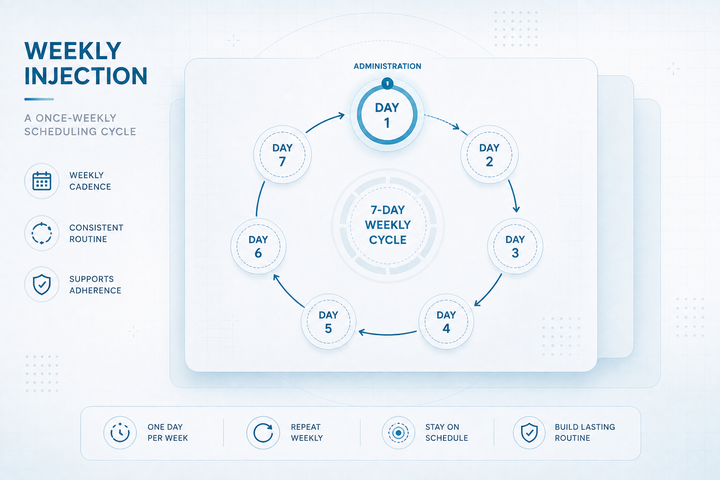
Weekly injection

The weekly-injection concept is most usefully framed as a pharmacological exposure pattern that can be related to receptor-mediated biology. Semaglutide interacts with the GLP-1 biology of target tissues through receptor signaling, while mechanism provides the causal framework for interpreting downstream effects. Pharmacokinetics describes concentration and disposition, whereas pharmacodynamics describes biological response. Together, these concepts distinguish drug exposure from receptor activation and from downstream endocrine, gastrointestinal, appetite, and metabolic processes.

Semaglutide interpretation can then be organized around linked physiological domains rather than a single endpoint. Pancreatic signaling connects with glycemic control, while variation in glucose trajectories can be considered through glycemic variability. Metabolic context includes insulin resistance and metabolic outcomes, while central and gastrointestinal signaling intersects with appetite regulation. These relationships describe biological pathways, not predetermined clinical responses.

The same framework can be placed within broader clinical pharmacology by separating molecular action, tissue response, exposure-response relationships, and observed physiological endpoints. Evidence from clinical trials may evaluate multiple domains simultaneously, but trial observations remain distinct from mechanistic inference. Contexts including type 2 diabetes, prediabetes, and obesity can alter the physiological background against which pharmacodynamic signals are interpreted, without implying uniformity across individuals.

Mechanistic layer Primary interpretation
Pharmacokinetics Drug concentration, absorption, distribution, metabolism, and elimination
Pharmacodynamics Receptor activation and downstream biological signaling
Systems physiology Endocrine, gastrointestinal, appetite, and metabolic pathway integration

PK/PD Relevance to Weekly Administration Biology

Pharmacokinetic interpretation provides the foundation for understanding semaglutide exposure over an extended temporal context. Pharmacokinetics addresses absorption, distribution, metabolism, and elimination, while clinical pharmacology integrates these processes with physiological context. Pharmacodynamics then considers how exposure relates to GLP-1 receptor signaling. The resulting framework helps distinguish concentration-time behavior from biological response, receptor occupancy concepts, downstream signaling, and the eventual measurement of endocrine or metabolic variables.

Extended exposure does not mean that concentration and effect are interchangeable. Semaglutide exposure can be considered alongside GLP-1 biology and mechanism, with downstream effects involving insulin and glucagon signaling, gastrointestinal physiology, and appetite-regulatory pathways. Relationships with glycemic control and glycemic variability represent pharmacodynamic domains, whereas insulin resistance represents a physiological context. These layers should not be collapsed into a single exposure-response variable.

Temporal interpretation also matters when comparing mechanistic evidence across experimental settings. Clinical trials may capture endpoints at different times from pharmacokinetic sampling, and effectiveness overview materials may describe observed outcomes rather than molecular causality. In metabolic settings such as type 2 diabetes, prediabetes, or obesity, baseline physiology can influence interpretation. The mechanistic task is therefore to connect exposure, signaling, physiology, and measurement without assuming identical temporal behavior across endpoints.

PK/PD component Mechanistic relevance Interpretive distinction
Exposure Concentration-time behavior Describes pharmacokinetic state
Receptor signaling GLP-1 receptor activation Represents pharmacodynamic initiation
Physiological endpoint Endocrine or metabolic response May occur downstream of signaling

Endocrine-Linked Weekly Injection Considerations

Endocrine interpretation centers on semaglutide-mediated GLP-1 receptor signaling within physiological systems involved in glucose regulation. GLP-1 biology provides the molecular foundation, while mechanism describes receptor-linked intracellular signaling. Pharmacodynamics connects receptor activation with endocrine processes, and pharmacokinetics establishes the exposure context. Pancreatic insulin and glucagon pathways can subsequently be interpreted alongside glycemic control and glycemic variability as distinct but connected physiological domains.

Endocrine-linked interpretation also requires attention to metabolic background. Insulin resistance can alter the physiological environment in which glucose-regulatory signaling occurs, while type 2 diabetes and prediabetes represent different metabolic contexts. Clinical pharmacology helps separate drug-specific pharmacology from disease-associated physiology. The weekly-injection concept therefore functions as a temporal exposure framework rather than a standalone endocrine endpoint, and mechanistic interpretation should preserve distinctions between receptor signaling, hormone secretion, and measured glucose variables.

Endocrine physiology also interacts with gastrointestinal and appetite pathways. Appetite regulation can influence nutrient intake and metabolic substrate availability, while gastrointestinal signaling can affect the timing and handling of nutrients. Metabolic outcomes represent a broader downstream category rather than a direct measure of receptor activity. Evidence from clinical trials can inform how these domains are measured together, but mechanistic interpretation remains dependent on endpoint definitions, sampling time, baseline physiology, and the distinction between association and direct pharmacological action.

Endocrine pathway Mechanistic relationship
GLP-1 receptor signaling Initiates intracellular signaling relevant to endocrine physiology
Insulin and glucagon Downstream pancreatic hormone pathways
Glucose regulation Physiological endpoint influenced by multiple regulatory systems

Gastrointestinal-Linked Weekly Injection Considerations

Gastrointestinal interpretation begins with the relationship between GLP-1 receptor signaling and digestive physiology. GLP-1 biology describes endogenous signaling principles, while mechanism frames semaglutide-associated receptor activation. Pharmacodynamics addresses downstream physiological responses, whereas pharmacokinetics establishes the temporal exposure environment. Gastrointestinal processes can intersect with appetite regulation, nutrient transit, gastric motor activity, and endocrine signaling, making GI interpretation inherently multi-system rather than isolated.

The gastrointestinal domain is also relevant to interpretation of nutrient-dependent metabolic signals. Changes in digestive physiology can alter the temporal relationship between nutrient availability and endocrine responses, which can then intersect with glycemic control and glycemic variability. Clinical pharmacology provides a framework for distinguishing gastrointestinal pharmacodynamics from systemic exposure. The mechanistic concept does not require assuming that every gastrointestinal signal maps directly onto appetite, glucose, or broader metabolic outcomes.

Gastrointestinal pathways can also contribute to variability in observed pharmacodynamic patterns. Obesity, type 2 diabetes, and other metabolic contexts may involve different baseline gastrointestinal and endocrine physiology. Clinical trials can examine gastrointestinal and metabolic variables together, while effectiveness overview material may summarize downstream observations. Mechanistically, the relevant question is how exposure, receptor signaling, gastrointestinal function, nutrient handling, and downstream endpoints relate, without treating any one pathway as a complete explanation of the others.

GI process Mechanistic interpretation Related domain
Gastrointestinal signaling GLP-1-linked digestive physiology Endocrine signaling
Gastric motor activity Modulates temporal nutrient handling Glycemic physiology
Nutrient transit Influences nutrient availability Appetite and metabolism

Appetite-Linked Weekly Injection Considerations

Appetite-linked interpretation concerns the interaction between GLP-1 receptor signaling and neural, gastrointestinal, and endocrine systems involved in feeding behavior. Appetite regulation provides the primary physiological framework, while GLP-1 biology and mechanism describe receptor-mediated signaling. Pharmacodynamics relates signaling to biological response, and pharmacokinetics provides exposure context. Appetite should therefore be viewed as an integrated physiological domain rather than as a direct surrogate for drug concentration.

Central appetite circuits interact with gastrointestinal feedback and metabolic state. Nutrient-related signals can converge with appetite regulation, while downstream changes in intake can alter the metabolic environment associated with insulin resistance, glycemic control, and metabolic outcomes. Clinical pharmacology helps distinguish direct pharmacodynamic effects from secondary physiological consequences. This distinction is important because appetite-related observations can arise from several interacting signals rather than from one isolated receptor pathway.

Interpretive variability is especially relevant because appetite is influenced by behavioral, neural, gastrointestinal, endocrine, and metabolic inputs. Contexts such as obesity and weight management provide physiological and research settings in which appetite endpoints may be evaluated. Clinical trials can characterize appetite-related measures alongside metabolic endpoints, but these measures should not automatically be treated as interchangeable. Mechanistic interpretation instead considers exposure, receptor signaling, central pathways, gastrointestinal feedback, and metabolic context as interacting layers.

Appetite component Mechanistic layer
Central signaling Neural integration of feeding-related signals
Gastrointestinal feedback Peripheral signals contributing to appetite regulation
Metabolic state Energy and nutrient context influencing feeding physiology

Metabolic-Linked Weekly Injection Considerations

Metabolic interpretation connects semaglutide pharmacology with interconnected pathways regulating glucose, insulin, glucagon, nutrient availability, and energy balance. Mechanism and GLP-1 biology establish the receptor-signaling foundation, while pharmacokinetics and pharmacodynamics distinguish exposure from biological response. Insulin resistance describes an important metabolic context, while glycemic control and glycemic variability represent separate dimensions of glucose physiology.

The metabolic system is not a single pathway, so interpretation requires attention to interactions among endocrine, gastrointestinal, appetite, and energy-balance signals. Appetite regulation can influence nutrient intake, while gastrointestinal processes can influence nutrient delivery and endocrine timing. Metabolic outcomes represent downstream categories that may incorporate multiple physiological processes. Clinical pharmacology provides the conceptual structure for distinguishing direct receptor-mediated pharmacology from secondary metabolic changes and for interpreting temporal relationships among these variables.

Metabolic context also affects how pharmacodynamic observations are understood across populations and study designs. Type 2 diabetes, prediabetes, and obesity involve differing baseline metabolic states that can influence measured endpoints without changing the fundamental receptor mechanism. Clinical trials can provide structured evidence about metabolic endpoints, whereas an effectiveness overview may synthesize observations at a broader level. Mechanistic analysis keeps these evidence layers conceptually separate.

Metabolic domain Mechanistic relevance Endpoint category
Insulin signaling Central to glucose and nutrient regulation Endocrine physiology
Glucose dynamics Reflects integrated regulatory processes Glycemic endpoints
Energy balance Links intake, expenditure, and nutrient state Metabolic physiology

Variability in Weekly-Injection-Related Response

Variability in semaglutide response can be considered mechanistically as variation across exposure, receptor signaling, physiological state, and endpoint measurement. Pharmacokinetics addresses differences in drug disposition, while pharmacodynamics addresses differences in biological response. Clinical pharmacology integrates these dimensions, and GLP-1 biology plus mechanism establish the common molecular framework. Observed variability therefore does not necessarily indicate variability in the fundamental receptor mechanism itself.

Physiological context can contribute to heterogeneity in measured responses. Insulin resistance influences metabolic background, while glycemic control and glycemic variability represent different glucose-related measurements. Appetite regulation involves additional neural and gastrointestinal inputs, and metabolic outcomes can integrate multiple downstream processes. These domains may therefore display different degrees and patterns of variability even when exposure is considered within the same general pharmacological framework.

Evidence interpretation requires separating biological heterogeneity from differences in study design and endpoint definition. Clinical trials can control some sources of variation through standardized measurement, while effectiveness overview material may encompass broader populations and settings. Type 2 diabetes, prediabetes, and obesity provide different physiological backgrounds. Mechanistic interpretation therefore treats response variability as a multidimensional phenomenon involving exposure, biology, context, and measurement rather than as a single unexplained characteristic.

Source of variability Interpretive layer
Exposure variability Pharmacokinetic disposition
Biological variability Receptor and downstream physiology
Measurement variability Endpoint definition and sampling context

Weekly Injection Interpretation and Glycemic Endpoints

Glycemic interpretation requires distinguishing the temporal exposure concept from the glucose endpoints used to characterize physiology. Pharmacokinetics describes semaglutide concentration over time, while pharmacodynamics describes biological response. Glycemic control summarizes glucose regulation across defined measurements, whereas glycemic variability addresses fluctuations rather than a single average. GLP-1 biology and mechanism explain upstream receptor-linked processes without making the endpoint itself synonymous with receptor activation.

Endocrine and gastrointestinal pathways can mediate or modify the relationship between exposure and glucose measurements. Insulin and glucagon signaling can be interpreted alongside insulin resistance, while gastrointestinal physiology and appetite regulation can influence nutrient availability. Clinical pharmacology provides the framework for distinguishing direct pharmacodynamic mechanisms from indirect physiological effects. Consequently, a glycemic endpoint is best understood as an integrated measurement arising from several interacting systems rather than as a direct readout of semaglutide exposure alone.

Different metabolic settings can change the interpretation of glycemic measurements. Type 2 diabetes and prediabetes involve different baseline glucose-regulatory environments, while obesity may provide another metabolic context for research. Clinical trials define how endpoints are collected and analyzed, while metabolic outcomes can encompass broader measures. Mechanistic interpretation therefore preserves distinctions between exposure, endocrine signaling, gastrointestinal physiology, appetite-related processes, and observed glycemic endpoints.

Glycemic concept Mechanistic meaning Measurement focus
Glycemic control Integrated glucose-regulatory state Glucose-related endpoint
Glycemic variability Temporal fluctuation in glucose Pattern and dispersion
Pharmacodynamic response Biological response to receptor signaling Exposure-response relationship

Weekly Injection Interpretation and Metabolic Endpoints

Metabolic endpoints represent downstream physiological measurements that can integrate several semaglutide-linked pathways. Pharmacodynamics provides the response framework, while pharmacokinetics establishes exposure context. GLP-1 biology and mechanism describe receptor-linked signaling, whereas metabolic outcomes encompass broader physiological categories. Insulin resistance can shape baseline metabolic physiology, making it important to distinguish a drug-mediated signal from the pre-existing metabolic environment.

Metabolic integration includes glucose regulation, nutrient handling, appetite, and endocrine signaling. Glycemic control and glycemic variability provide glucose-specific perspectives, while appetite regulation addresses feeding-related physiology. Gastrointestinal signaling can connect nutrient transit with endocrine responses. Clinical pharmacology helps place these pathways within a coherent exposure-response model. The weekly-injection concept is therefore a temporal pharmacology construct that can coexist with several distinct metabolic endpoints without making those endpoints interchangeable.

Interpretation across metabolic contexts requires attention to baseline physiology and evidence design. Type 2 diabetes, prediabetes, and obesity can involve different endocrine and metabolic states. Clinical trials can isolate predefined metabolic measurements, while effectiveness overview sources may combine heterogeneous evidence. Mechanistic interpretation should therefore distinguish molecular action, physiological mediation, endpoint definition, and population context rather than assigning a single causal pathway to every metabolic observation.

Endpoint domain Upstream pathway Interpretive level
Glucose regulation Endocrine and metabolic signaling Integrated physiology
Energy balance Appetite and nutrient pathways Systems physiology
Metabolic state Multiple interacting pathways Downstream endpoint

Multi-System Integration of Weekly Injection Biology

A systems-level interpretation links semaglutide exposure with receptor signaling and multiple physiological domains. Pharmacokinetics describes exposure, pharmacodynamics describes response, and GLP-1 biology establishes the signaling framework. Mechanism connects receptor activation to downstream processes, while clinical pharmacology organizes exposure-response relationships. Endocrine, gastrointestinal, appetite, and metabolic pathways should then be considered as interacting biological systems rather than independent pharmacological compartments.

The endocrine layer includes insulin and glucagon signaling and connects with glycemic control, glycemic variability, and insulin resistance. The gastrointestinal layer contributes nutrient-handling signals, while appetite regulation integrates central and peripheral feeding-related inputs. Broader metabolic outcomes can reflect the combined influence of these pathways. This architecture emphasizes that mechanistic interpretation concerns relationships among systems, not a single isolated pathway or endpoint.

Systems integration also requires evidence-context separation. Clinical trials can provide controlled observations across endocrine, gastrointestinal, appetite, and metabolic variables, while effectiveness overview material may summarize heterogeneous evidence. Physiological contexts such as type 2 diabetes, prediabetes, and obesity may differ in baseline signaling and endpoint behavior. A multi-system model therefore preserves uncertainty, distinguishes direct from indirect effects, and avoids converting mechanistic relationships into outcome predictions or patient-level conclusions.

System Primary mechanistic connection Integrated endpoint
Endocrine Pancreatic hormone signaling Glucose regulation
Gastrointestinal Nutrient and motor signaling Nutrient handling
Appetite/metabolic Central and peripheral energy signals Energy-balance physiology

Interpreting Weekly Administration Biology in Mechanistic Evidence

Mechanistic evidence concerning semaglutide can be organized by separating molecular, pharmacokinetic, pharmacodynamic, physiological, and clinical-evidence layers. Mechanism describes receptor-linked action, GLP-1 biology provides physiological context, pharmacokinetics describes exposure, and pharmacodynamics describes response. Clinical pharmacology integrates these layers. The weekly-injection concept is consequently interpreted as part of temporal exposure biology rather than as evidence for any particular clinical outcome.

Mechanistic interpretation becomes more informative when endocrine, gastrointestinal, appetite, and metabolic pathways are mapped together. Glycemic control and glycemic variability represent glucose domains, while appetite regulation represents feeding physiology and insulin resistance represents metabolic context. Metabolic outcomes can sit farther downstream. These distinctions help prevent endpoint observations from being interpreted as direct measurements of receptor activity or drug concentration.

Evidence hierarchy also matters when considering the meaning of observed associations. Clinical trials can characterize predefined physiological endpoints under specified research conditions, while effectiveness overview materials can summarize observations across broader evidence bases. Contexts including type 2 diabetes, prediabetes, obesity, and weight management may involve different endpoint frameworks. Mechanistic evidence is strongest when exposure, signaling, physiology, timing, measurement, and study context are kept analytically distinct.

Evidence layer Question addressed
Molecular mechanism How does receptor-linked signaling operate?
PK/PD evidence How does exposure relate to biological response?
Clinical evidence How are predefined physiological endpoints measured?

Frequently Asked Questions

Mechanistically, the weekly-injection concept refers to interpreting semaglutide as a pharmacological exposure pattern associated with prolonged systemic presence and sustained receptor-related pharmacology. The concept is not itself a biological endpoint. Interpretation requires separating drug concentration over time from GLP-1 receptor signaling, downstream endocrine activity, gastrointestinal physiology, appetite regulation, and metabolic measurements. These layers can interact, but they are not equivalent. A mechanistic framework therefore focuses on exposure, receptor signaling, physiological mediation, and endpoint measurement as distinct components of pharmacological interpretation.

Weekly administration biology can be understood as a temporal pharmacology concept involving how an extended exposure pattern relates to semaglutide pharmacokinetics and pharmacodynamics. The relevant biology includes absorption, systemic disposition, receptor engagement, intracellular signaling, and downstream physiological processes. Endocrine, gastrointestinal, appetite, and metabolic responses may occur on related but nonidentical temporal scales. Consequently, the phrase describes a framework for organizing exposure and biological response over time rather than establishing a specific clinical result or implying that all physiological effects follow the same time course.

Pharmacokinetics and pharmacodynamics provide complementary perspectives. Pharmacokinetics describes the concentration-time behavior of semaglutide, including processes governing systemic exposure and disposition. Pharmacodynamics addresses how that exposure relates to receptor-mediated biological activity and downstream responses. The two should not be treated as interchangeable because a measured concentration is not identical to a physiological endpoint. Interpretation also requires considering receptor signaling, endocrine physiology, gastrointestinal processes, appetite-related pathways, metabolic state, sampling time, and endpoint definitions when relating exposure to observed biological measurements.

Endocrine relevance arises primarily from GLP-1 receptor signaling and its relationship to pancreatic and metabolic physiology. Insulin and glucagon pathways are downstream components of glucose regulation, but measured glucose variables also depend on insulin sensitivity, nutrient availability, gastrointestinal physiology, and other regulatory systems. A weekly-injection interpretation therefore considers endocrine signaling within a broader exposure-response framework. It distinguishes molecular receptor activity from hormone secretion and from downstream glycemic measurements, avoiding the assumption that any single endocrine variable directly represents the complete pharmacological action.

Gastrointestinal pathways are relevant because GLP-1 signaling intersects with digestive physiology, nutrient transit, gastric motor activity, and feedback signals involved in feeding and metabolic regulation. These processes can influence the timing and availability of nutrients and thereby interact with endocrine and glycemic physiology. Mechanistic interpretation should distinguish gastrointestinal pharmacodynamics from systemic drug exposure and from downstream endpoints. Gastrointestinal observations may also interact with appetite and metabolic measurements, so they are best understood as components of an interconnected physiological network rather than as isolated indicators of semaglutide activity.

Appetite biology involves coordinated neural, gastrointestinal, endocrine, and metabolic signals rather than a single pathway. Semaglutide-related GLP-1 receptor signaling can therefore be interpreted within a network involving central feeding circuits and peripheral physiological feedback. Appetite-related measurements are distinct from pharmacokinetic exposure and from direct receptor activity. They can also influence nutrient intake and consequently alter metabolic context. A mechanistic interpretation separates direct pharmacodynamic signaling from secondary physiological relationships and recognizes that appetite endpoints may have different temporal and biological characteristics from endocrine or glycemic measurements.

Metabolic physiology integrates glucose regulation, insulin sensitivity, nutrient availability, energy balance, and endocrine signaling. Semaglutide pharmacology can be placed within this network by distinguishing receptor-mediated signaling from downstream metabolic measurements. Insulin resistance represents a background physiological state, while glycemic control, glycemic variability, and broader metabolic endpoints represent different measurement domains. Appetite and gastrointestinal processes can also affect metabolic context through nutrient intake and handling. Thus, weekly-injection interpretation is best viewed as a temporal exposure framework embedded within interconnected metabolic physiology rather than as a standalone metabolic endpoint.

Variability can arise from differences in pharmacokinetic exposure, pharmacodynamic sensitivity, baseline metabolic state, endocrine physiology, gastrointestinal function, appetite regulation, and endpoint measurement. These sources of variation should be distinguished because they represent different biological or methodological layers. A common molecular mechanism does not require identical downstream measurements across physiological settings. Conditions involving altered glucose regulation, insulin sensitivity, energy balance, or gastrointestinal physiology may provide different backgrounds for interpreting pharmacodynamic observations. Study design, sampling time, endpoint definitions, and population characteristics can further contribute to apparent response variability.

Weekly injection biology describes a temporal pharmacological framework, whereas glycemic endpoints are measurements of glucose-related physiology. Pharmacokinetic exposure concerns drug concentration over time, while pharmacodynamic activity concerns biological response to receptor signaling. Glycemic measures are downstream and can reflect endocrine regulation, insulin sensitivity, nutrient availability, gastrointestinal processes, and other physiological influences. Glycemic control and glycemic variability also represent different measurement concepts. Therefore, a glycemic endpoint should not be treated as a direct or complete measurement of semaglutide exposure, receptor activation, or the entire pharmacodynamic process.

Metabolic endpoints generally represent downstream measurements integrating several physiological systems, whereas weekly injection biology concerns temporal pharmacological exposure and its relationship to biological signaling. Metabolic measurements may reflect endocrine activity, glucose regulation, appetite-related changes, gastrointestinal nutrient handling, insulin sensitivity, and broader energy-balance processes. Because these pathways interact, an observed metabolic endpoint cannot automatically be assigned to a single receptor mechanism. Mechanistic interpretation therefore separates exposure, receptor signaling, physiological mediation, and endpoint measurement while considering the metabolic context in which the observation was generated.

Appetite endpoints describe feeding-related physiology, including neural and peripheral signals that influence hunger, satiety, food intake, and related behaviors. Weekly injection biology instead describes a temporal pharmacological exposure framework. The two can be mechanistically connected through GLP-1 receptor signaling, gastrointestinal feedback, and central appetite-regulatory pathways, but they are not synonymous. Appetite measurements can also be influenced by behavioral and physiological factors beyond drug exposure. A rigorous interpretation therefore treats appetite as one downstream domain within a larger pharmacodynamic and systems-physiology model.

Mechanistic evidence helps connect molecular receptor activity with pharmacokinetic exposure, pharmacodynamic response, endocrine signaling, gastrointestinal physiology, appetite regulation, and metabolic measurements. It also helps distinguish direct effects from indirect or downstream relationships. Evidence from receptor biology, experimental pharmacology, pharmacokinetic studies, pharmacodynamic analyses, and clinical research can address different layers of this framework. No single evidence type necessarily describes the entire system. Mechanistic interpretation is therefore most informative when evidence is aligned with the specific biological question and when molecular, physiological, temporal, and clinical-evidence layers remain conceptually distinct.