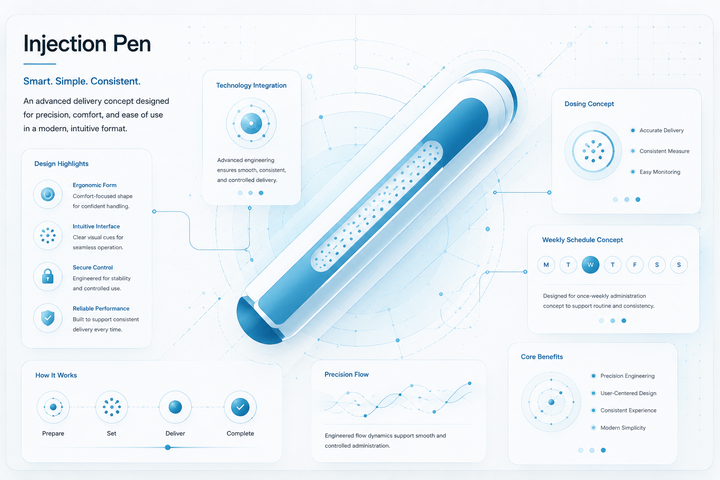
A semaglutide injection pen can be interpreted mechanistically as a device-mediated delivery interface linking pharmaceutical formulation with subcutaneous deposition and systemic exposure. This framework connects GLP-1 biology, mechanism, pharmacokinetics, and clinical pharmacology while separating device characteristics from downstream physiological endpoints and avoiding assumptions about clinical outcomes.
Device-based interpretation focuses on the sequence from delivery-system function to absorption, distribution, receptor engagement, and biological signaling. Pharmacodynamics, pharmacokinetics, GLP-1 biology, and mechanism provide complementary frameworks. Endocrine, gastrointestinal, appetite, and metabolic physiology can then be considered as downstream systems without converting device characteristics into outcome claims.
The pen concept also intersects with appetite regulation, glycemic control, glycemic variability, and insulin resistance. Broader contexts such as metabolic outcomes, obesity, and clinical trials help distinguish device-mediated exposure from physiological measurement and evidence interpretation.
Device-based interpretation examines how a delivery system forms the interface between a pharmaceutical formulation and biological tissue. For semaglutide, the injection pen can be considered upstream of pharmacokinetics, while pharmacodynamics describes downstream biological response. GLP-1 biology, mechanism, and clinical pharmacology provide frameworks for separating device-mediated delivery from receptor signaling and physiological endpoints.
The mechanistic sequence includes device operation, formulation release, deposition within subcutaneous tissue, local absorption, systemic distribution, and subsequent receptor-mediated activity. These layers can be connected with pharmacokinetics, pharmacodynamics, GLP-1 biology, and mechanism. Downstream domains such as glycemic control and appetite regulation remain physiological endpoints rather than properties of the device itself.
A mechanistic device model also allows variability to be separated into technical, pharmacokinetic, and biological components. Device characteristics, subcutaneous tissue properties, formulation behavior, systemic exposure, receptor signaling, and metabolic state can all represent distinct variables. Relevant contexts include clinical pharmacology, glycemic variability, insulin resistance, metabolic outcomes, and clinical trials.
| Device layer | Mechanistic focus | Biological interface |
|---|---|---|
| Delivery system | Formulation release and deposition | Subcutaneous tissue |
| Absorption | Entry into systemic circulation | Pharmacokinetic exposure |
| Downstream signaling | GLP-1 receptor activity | Endocrine and metabolic systems |
Pharmacokinetic interpretation describes the concentration-time profile established after semaglutide reaches systemic circulation, while pharmacodynamics describes biological signaling associated with exposure. The injection pen is positioned upstream within this sequence. Pharmacokinetics, pharmacodynamics, clinical pharmacology, and mechanism therefore connect device-mediated delivery with molecular pharmacology.
Subcutaneous delivery involves deposition into tissue followed by absorption into systemic circulation. The resulting exposure profile depends on formulation properties, local tissue conditions, and biological disposition. These processes can be analyzed alongside GLP-1 biology, pharmacokinetics, and pharmacodynamics. Downstream physiological domains include glycemic control, appetite regulation, and metabolic outcomes.
PK/PD interpretation should distinguish the device from exposure and exposure from biological response. A delivery-system variable may affect the initial stage of the sequence, whereas systemic concentration and receptor engagement belong to pharmacokinetic and pharmacodynamic domains. Relevant evidence frameworks include clinical pharmacology, clinical trials, glycemic variability, insulin resistance, and obesity.
| PK/PD stage | Mechanistic interpretation |
|---|---|
| Device delivery | Subcutaneous deposition of formulation |
| PK | Absorption and systemic concentration |
| PD | GLP-1 receptor-mediated biological signaling |
Endocrine-linked device interpretation begins with delivery and exposure rather than assuming a direct device-to-hormone relationship. GLP-1 biology describes receptor-mediated signaling, mechanism describes pathway organization, and pharmacokinetics describes systemic exposure. Pharmacodynamics and clinical pharmacology then provide the framework for interpreting downstream endocrine physiology.
Endocrine pathways can intersect with insulin, glucagon, glucose regulation, energy balance, and gastrointestinal signaling. A pen is part of the delivery chain, whereas endocrine signaling occurs downstream of systemic drug exposure and receptor engagement. Relevant physiological domains include insulin resistance, glycemic control, appetite regulation, and metabolic outcomes. These pathways should remain analytically distinct.
Endocrine interpretation also requires attention to feedback, receptor distribution, tissue responsiveness, and temporal exposure. Pharmacokinetics supplies the exposure dimension, while pharmacodynamics supplies the response dimension. Broader contexts such as type 2 diabetes, prediabetes, obesity, and clinical trials can describe physiological settings without establishing a device-specific endocrine outcome.
| Endocrine layer | Device-related position |
|---|---|
| Delivery | Upstream of systemic exposure |
| GLP-1 signaling | Downstream receptor-mediated process |
| Endocrine physiology | Integrated biological context |
Although an injection pen delivers semaglutide through a subcutaneous route, gastrointestinal physiology remains relevant to downstream GLP-1 signaling and systemic metabolic context. GLP-1 biology, mechanism, and pharmacodynamics describe these downstream pathways, while pharmacokinetics describes systemic exposure. Clinical pharmacology connects delivery with the broader physiological sequence.
Gastrointestinal physiology includes gut hormone signaling, gastric function, intestinal nutrient sensing, neural communication, and metabolic signaling. These pathways can coexist with semaglutide exposure established after subcutaneous delivery. Relevant concepts include appetite regulation, glycemic control, glycemic variability, and metabolic outcomes. The gastrointestinal system is therefore a downstream physiological context rather than the delivery site for an injection pen.
Device-based analysis can distinguish subcutaneous absorption from gastrointestinal pharmacodynamics. This separation is useful because gastrointestinal signaling may participate in the biological response even though the delivery route does not involve gastrointestinal absorption. Pharmacokinetics, pharmacodynamics, GLP-1 biology, appetite regulation, and clinical pharmacology allow these distinct mechanisms to be evaluated within one systems framework.
| GI domain | Mechanistic relationship | Device relationship |
|---|---|---|
| Gut signaling | GLP-1-associated physiology | Downstream of injection delivery |
| Nutrient sensing | Metabolic and endocrine signaling | Physiological context |
| GI absorption | Not the injection delivery pathway | Distinct from subcutaneous absorption |
Appetite regulation is a downstream pharmacodynamic domain rather than a property of the injection pen itself. Appetite regulation describes central and peripheral energy-intake pathways, while GLP-1 biology and mechanism describe relevant signaling. Pharmacokinetics, pharmacodynamics, and clinical pharmacology establish the connection between delivery, exposure, and biological response.
Central appetite networks integrate hypothalamic, brainstem, gastrointestinal, endocrine, and metabolic signals. A device establishes the delivery interface, but appetite-related physiology depends on systemic exposure and receptor-mediated signaling. Related pathways include glycemic control, insulin resistance, metabolic outcomes, and obesity. These domains provide physiological context without making device-specific appetite claims.
Mechanistic interpretation can therefore model the pen as an upstream component in a longer causal chain. Device delivery is followed by absorption, distribution, receptor engagement, and integrated appetite signaling. Pharmacokinetics, pharmacodynamics, appetite regulation, weight management, and clinical trials support separate analysis of exposure, physiology, and endpoints. This preserves a distinction between device biology and appetite measurements.
| Layer | Mechanistic role | Relationship to device |
|---|---|---|
| Pen delivery | Subcutaneous drug deposition | Upstream variable |
| Systemic exposure | Circulating semaglutide | PK bridge |
| Appetite signaling | Central-peripheral physiology | Downstream PD domain |
Metabolic interpretation separates device-mediated delivery from downstream glucose and energy physiology. GLP-1 biology provides receptor context, mechanism organizes signaling pathways, and pharmacokinetics describes systemic exposure following subcutaneous absorption. Pharmacodynamics describes downstream biological activity, while clinical pharmacology integrates these levels.
Metabolic physiology includes glucose-dependent insulin secretion, glucagon regulation, hepatic glucose production, peripheral glucose handling, and energy balance. The pen is positioned before these physiological processes in the exposure-response sequence. Relevant domains include insulin resistance, glycemic control, glycemic variability, and metabolic outcomes. These endpoints should not be treated as direct properties of the delivery device.
Metabolic context may vary according to baseline physiology and biological state. Type 2 diabetes, prediabetes, obesity, and weight management represent different contexts in which exposure and metabolic endpoints can be studied. Evidence from clinical trials should distinguish device characteristics, pharmacokinetics, pharmacodynamics, and measured metabolic variables rather than merging these categories.
| Metabolic domain | Mechanistic position | Device relationship |
|---|---|---|
| Glucose regulation | Downstream pharmacodynamics | Indirect |
| Insulin signaling | GLP-1-associated metabolic pathway | Downstream |
| Energy balance | Integrated metabolic physiology | Contextual |
Device-related variability can be analyzed across technical delivery, formulation behavior, subcutaneous absorption, systemic exposure, receptor signaling, and physiological response. Pharmacokinetics describes exposure variability, while pharmacodynamics describes biological response. Clinical pharmacology, mechanism, and GLP-1 biology provide frameworks for separating these sources rather than attributing every difference to the device.
Subcutaneous tissue characteristics, formulation properties, delivery-system variables, systemic disposition, and biological responsiveness can all contribute to heterogeneity in the exposure-response sequence. These variables can coexist with differences in insulin resistance, glycemic control, glycemic variability, and appetite regulation. Mechanistic interpretation therefore requires multiple levels of analysis rather than a single device-centered explanation.
Study populations can also differ in baseline metabolic state, body composition, physiological responsiveness, and endpoint measurement. Relevant contexts include obesity, type 2 diabetes, prediabetes, and clinical trials. Broader metabolic outcomes and weight management contexts may contain overlapping variables. Variability should therefore be decomposed into device, PK, PD, and physiological components.
| Variability source | Mechanistic dimension | Interpretive layer |
|---|---|---|
| Device | Delivery-system characteristics | Technical |
| Subcutaneous tissue | Local absorption environment | PK |
| Biological state | Receptor and physiological responsiveness | PD |
An injection pen is a delivery-system component, whereas glycemic endpoints are measurements of glucose-related physiology. Pharmacokinetics connects delivery with systemic exposure, while pharmacodynamics connects exposure with biological signaling. GLP-1 biology, mechanism, and clinical pharmacology allow these layers to be separated from glycemic measurements.
Glycemic endpoints reflect processes including glucose regulation, insulin secretion, glucagon physiology, hepatic glucose production, and peripheral glucose utilization. Relevant frameworks include glycemic control, glycemic variability, and insulin resistance. A device characteristic does not constitute a glycemic endpoint, and a glycemic measurement cannot by itself establish a device-specific mechanism.
Mechanistic evidence can examine the sequence from delivery to exposure to receptor signaling and then to glycemic physiology. Pharmacokinetics, pharmacodynamics, metabolic outcomes, type 2 diabetes, and clinical trials provide relevant analytical contexts. Interpretation remains dependent on endpoint definition, temporal relationships, biological variability, and evidence specificity.
| Concept | Primary question |
|---|---|
| Device | How is the formulation delivered? |
| PK/PD | What exposure and signaling follow delivery? |
| Glycemic endpoint | What glucose physiology is measured? |
Metabolic endpoints describe physiological states or measurements, whereas an injection pen describes a pharmaceutical delivery interface. Mechanism, pharmacokinetics, and pharmacodynamics connect these levels without making them interchangeable. GLP-1 biology provides receptor context, while clinical pharmacology organizes exposure-response interpretation.
Metabolic endpoints can encompass glucose regulation, insulin resistance, energy balance, substrate utilization, and related physiology. Relevant domains include insulin resistance, glycemic control, glycemic variability, and metabolic outcomes. The device contributes to the delivery stage, while metabolic endpoints arise downstream through receptor-mediated and integrated physiological pathways.
Interpretation becomes more precise when delivery, exposure, signaling, and endpoints are analyzed separately. Contexts such as obesity, weight management, type 2 diabetes, and prediabetes may influence baseline physiology. Clinical trials provide evidence structures in which formulation and metabolic variables can be distinguished according to study design and endpoint definition.
| Layer | Example focus | Classification |
|---|---|---|
| Injection pen | Delivery interface | Device variable |
| PK/PD | Exposure and receptor response | Pharmacological bridge |
| Metabolic endpoint | Glucose and energy physiology | Physiological measurement |
Appetite endpoints describe hunger, satiety, food intake, and related central-peripheral physiology, whereas the injection pen represents a delivery mechanism. Appetite regulation, GLP-1 biology, and mechanism describe downstream biological pathways. Pharmacokinetics, pharmacodynamics, and clinical pharmacology connect delivery with systemic exposure and receptor-mediated response.
Appetite physiology integrates neural circuits, gastrointestinal signals, endocrine inputs, and metabolic cues. A pen establishes the delivery interface but does not itself constitute an appetite measurement. Related domains include glycemic control, insulin resistance, metabolic outcomes, and obesity. These pathways can be evaluated together while preserving distinctions between device biology and appetite endpoints.
Mechanistic evidence can examine whether device-mediated delivery, systemic exposure, receptor signaling, and appetite measurements align temporally and biologically. Pharmacokinetics, pharmacodynamics, appetite regulation, weight management, and clinical trials provide analytical context. The important distinction is that a delivery-system variable is upstream, whereas appetite is an integrated physiological endpoint.
| Domain | Primary biological meaning |
|---|---|
| Device | Subcutaneous delivery interface |
| PK/PD | Exposure and receptor signaling |
| Appetite | Integrated hunger and satiety physiology |
A multi-system model places the injection pen at the beginning of a sequence that includes formulation release, subcutaneous deposition, absorption, systemic exposure, receptor signaling, and integrated physiology. GLP-1 biology, mechanism, pharmacokinetics, pharmacodynamics, and clinical pharmacology connect these layers.
Downstream systems include endocrine regulation, gastrointestinal signaling, appetite pathways, glucose metabolism, and energy homeostasis. Relevant frameworks include appetite regulation, glycemic control, glycemic variability, insulin resistance, and metabolic outcomes. The device is therefore one component within a larger pharmacological system rather than an isolated determinant of physiological behavior.
Systems integration also requires distinction between mechanism and endpoints. Contexts such as type 2 diabetes, prediabetes, obesity, and weight management can contain overlapping metabolic variables. Evidence from clinical trials and effectiveness overview should therefore be interpreted according to delivery characteristics, exposure, pharmacodynamics, biological variability, and endpoint definition.
| System layer | Mechanistic role | Device position |
|---|---|---|
| Delivery | Subcutaneous deposition | Primary device interface |
| PK/PD | Exposure and GLP-1 signaling | Downstream pharmacology |
| Endocrine/metabolic | Integrated physiology | Physiological context |
| Appetite/GI | Central-peripheral signaling | Downstream systems |
A semaglutide injection pen is a drug-delivery device that provides the physical interface between a pharmaceutical formulation and the biological tissue receiving the formulation. Mechanistically, it belongs upstream of subcutaneous deposition, absorption, systemic exposure, and receptor-mediated pharmacology. Interpretation can therefore consider device characteristics, formulation behavior, tissue absorption, pharmacokinetics, and pharmacodynamics as separate but connected stages. The pen itself is not a metabolic, endocrine, or appetite endpoint. Its mechanistic relevance lies in how a delivery system participates in the sequence leading from pharmaceutical presentation to biological exposure.
Device-based interpretation means analyzing the delivery system as one component of the pathway connecting a drug formulation with systemic pharmacology. For an injectable peptide, this pathway can include device-mediated release, subcutaneous deposition, local absorption, systemic distribution, receptor engagement, and downstream signaling. The approach separates technical delivery variables from pharmacokinetic exposure and pharmacodynamic response. It also distinguishes these pharmacological layers from clinical or physiological endpoints. Mechanistic interpretation therefore does not assume that a device characteristic independently determines an endocrine, gastrointestinal, appetite, metabolic, or glycemic outcome.
Pharmacokinetics and pharmacodynamics provide the principal bridge between device-mediated delivery and biological activity. Pharmacokinetics describes the concentration-time profile after absorption, including systemic disposition, while pharmacodynamics describes receptor engagement and downstream biological effects. An injection pen operates earlier in this sequence by providing the delivery interface and establishing subcutaneous deposition. Mechanistic analysis can therefore distinguish device characteristics, absorption, systemic exposure, receptor signaling, and physiological endpoints. This distinction prevents a delivery-system feature from being treated as equivalent to a pharmacokinetic measurement or a clinical endpoint.
Endocrine-linked device considerations concern the position of delivery within a larger hormonal signaling pathway. The device establishes a route to systemic exposure, after which semaglutide-associated GLP-1 receptor signaling can interact with broader endocrine physiology involving insulin, glucagon, glucose regulation, and energy homeostasis. Endocrine responses depend on exposure, receptor distribution, signaling pathways, feedback systems, and tissue responsiveness. Consequently, the device should be distinguished from endocrine mechanisms and endpoints. A delivery characteristic is an upstream pharmacological variable, not itself a measurement of endocrine function.
Gastrointestinal physiology can remain relevant after subcutaneous delivery because GLP-1 signaling participates in gut-brain communication, gastrointestinal regulation, nutrient sensing, and metabolic physiology. The injection route itself does not involve gastrointestinal absorption, so the gastrointestinal system represents a downstream physiological context rather than the primary delivery interface. Mechanistic interpretation can separate subcutaneous pharmacokinetics from gastrointestinal pharmacodynamics and signaling. This distinction is important because a biological pathway may involve gastrointestinal physiology even when the pharmaceutical delivery system establishes systemic exposure through subcutaneous tissue.
Appetite pathways are downstream physiological systems that can be considered after delivery, absorption, systemic exposure, and receptor signaling. They involve central neural circuits, gastrointestinal signals, endocrine inputs, and metabolic cues. The injection pen establishes the delivery interface but does not constitute an appetite endpoint. Mechanistic analysis therefore separates device characteristics from pharmacokinetics, pharmacodynamics, and integrated appetite physiology. This framework permits the biological sequence to be examined without treating a delivery-system property as a direct measure of hunger, satiety, food intake, or energy-balance physiology.
Metabolic pathways are downstream of delivery and systemic pharmacology. Semaglutide-associated GLP-1 signaling can be studied in relation to glucose-dependent insulin secretion, glucagon regulation, glucose handling, and broader energy metabolism. The injection pen establishes the physical delivery interface, while pharmacokinetics describes resulting systemic exposure and pharmacodynamics describes receptor-mediated signaling. Metabolic endpoints then reflect integrated physiological processes involving multiple pathways. Mechanistic interpretation therefore keeps device biology, exposure, receptor signaling, and metabolic measurements distinct, even when they are evaluated within the same experimental or clinical evidence framework.
Variation can arise at several levels, including device-mediated delivery, formulation behavior, subcutaneous tissue characteristics, absorption, systemic disposition, receptor responsiveness, and physiological state. Pharmacokinetic variability concerns exposure, whereas pharmacodynamic variability concerns biological response. Metabolic conditions, body composition, gastrointestinal physiology, appetite signaling, and baseline endocrine state can add further heterogeneity. Study design and measurement methods may also influence apparent differences. Mechanistically, these possibilities mean that an observed variation should not automatically be attributed to the device. Device, PK, PD, and physiological variables require separate consideration.
An injection device is a pharmaceutical delivery component, while glycemic endpoints are measurements of glucose-related physiology. The device participates in the early stages of the exposure sequence, including delivery and subcutaneous deposition. Pharmacokinetics then describes systemic exposure, and pharmacodynamics describes biological signaling. Glycemic endpoints reflect downstream processes such as glucose regulation, insulin secretion, glucagon physiology, and glucose utilization. Mechanistic interpretation therefore distinguishes the device from the endpoint. A glycemic measurement cannot by itself establish a device-specific mechanism, and a device characteristic is not a glycemic measurement.
Device biology concerns the physical and pharmaceutical processes associated with delivering semaglutide to biological tissue, whereas metabolic endpoints describe physiological measurements involving glucose, energy balance, substrate utilization, or related systems. Pharmacokinetics and pharmacodynamics provide the bridge between these levels. The device can influence the initial delivery stage, while downstream metabolic physiology depends on systemic exposure, receptor signaling, feedback, and broader biological context. Consequently, mechanistic analysis should identify whether evidence concerns delivery, exposure, signaling, or metabolism rather than treating all observations as components of the same endpoint.
Device interpretation concerns delivery-system characteristics and the pathway by which semaglutide reaches systemic circulation. Appetite endpoints concern hunger, satiety, food intake, and integrated neural, endocrine, gastrointestinal, and metabolic physiology. Pharmacokinetics and pharmacodynamics connect the two levels but do not make them interchangeable. A device characteristic therefore should not be interpreted as an appetite measurement. Mechanistic analysis can instead examine the sequence from delivery to exposure to receptor signaling and then to appetite-related physiology, while preserving the distinction between an upstream pharmaceutical variable and a downstream biological endpoint.
Mechanistic evidence clarifies how a delivery system participates in the sequence from pharmaceutical formulation to biological exposure and downstream signaling. Relevant evidence can include device characterization, formulation studies, subcutaneous absorption research, pharmacokinetic analyses, pharmacodynamic measurements, receptor biology, and controlled studies with clearly defined endpoints. This evidence helps separate technical delivery variables from exposure and physiological response. It also allows endocrine, gastrointestinal, appetite, and metabolic pathways to be interpreted as distinct layers. Mechanistic evidence therefore provides biological context without requiring assumptions about device superiority, usability, safety, or clinical outcomes.