Mechanistic focus • Clinically neutral

Semaglutide Glycemic Control — Mechanistic Endocrine, GI & Metabolic Integration

Semaglutide glycemic control is best understood through interacting physiological pathways rather than a single glucose-lowering mechanism. GLP-1 biology, mechanism, pharmacokinetics, and pharmacodynamics establish the pharmacological framework. Pancreatic endocrine signaling, hepatic glucose regulation, gastrointestinal physiology, and appetite regulation provide downstream metabolic context.

A1c is an integrated glycemic measurement rather than a direct receptor biomarker. Clinical pharmacology connects exposure with biological response, while glycemic variability, insulin resistance, and metabolic outcomes describe related but distinct physiological domains. Mechanistic interpretation therefore separates proximal GLP-1 signaling from the multiple endocrine and metabolic processes contributing to longitudinal glycemic measurements.

Glycemic physiology also depends on interactions among pancreatic islets, liver, gastrointestinal signaling, appetite pathways, and systemic metabolism. Type 2 diabetes, prediabetes, and obesity represent different physiological contexts, while clinical trials provide structured evidence. This hub focuses on mechanistic interpretation of glycemic data without making A1c, effectiveness, superiority, or patient-level claims.

Semaglutide and Glycemic-Control Physiology
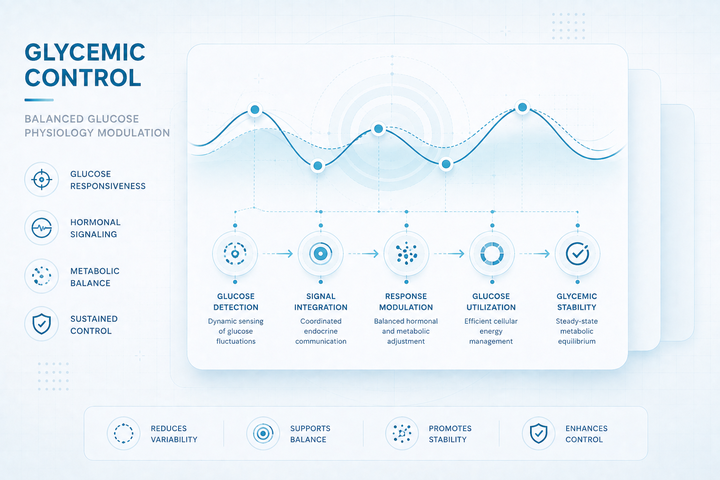
A1C chart

Glycemic control reflects coordinated regulation of glucose production, glucose disposal, nutrient absorption, and endocrine feedback. GLP-1 biology provides the receptor context for semaglutide, while mechanism describes downstream signaling. Pharmacodynamics addresses biological response, and clinical pharmacology integrates pharmacological and physiological observations. Insulin resistance and glycemic variability provide additional metabolic context, while metabolic outcomes represent more distal system-level measurements.

Semaglutide-related glycemic physiology can be considered through glucose-dependent pancreatic signaling, glucagon regulation, hepatic glucose handling, gastrointestinal processes, and appetite-related pathways. Pharmacodynamics connects receptor activation with biological responses, while pharmacokinetics establishes the systemic exposure environment. Appetite regulation can influence energy intake and nutrient availability, while insulin resistance modifies the metabolic background in which endocrine signaling occurs. These pathways are interconnected rather than strictly linear.

Glycemic endpoints therefore represent integrated physiology rather than isolated receptor activity. Glycemic variability describes temporal glucose fluctuations, while metabolic outcomes capture broader downstream processes. Type 2 diabetes and prediabetes provide different metabolic contexts, while clinical trials define how endpoints are measured. Clinical pharmacology helps distinguish direct pharmacological signaling from later physiological integration.

Physiological layer Mechanistic role Endpoint relationship
Pancreatic signaling Glucose-dependent endocrine regulation Proximal metabolic pathway
Hepatic regulation Control of endogenous glucose production Intermediate pathway
Integrated glycemia Combined endocrine and metabolic state Distal measurement

Glucose-Dependent Insulin Secretion

Glucose-dependent insulin secretion is a central endocrine component of GLP-1 physiology. GLP-1 biology describes receptor-mediated signaling in pancreatic beta cells, while mechanism connects receptor activation with intracellular pathways involved in insulin secretion. Pharmacodynamics characterizes the biological response, and clinical pharmacology integrates that response with exposure. Pharmacokinetics establishes the concentration-time context in which receptor signaling occurs.

The glucose dependence of insulinotropic signaling is important for mechanistic interpretation because beta-cell responses are linked to ambient glucose and nutrient conditions. Glycemic variability captures changes in glucose over time, while insulin resistance describes a separate determinant of metabolic physiology. Metabolic outcomes may integrate insulin secretion with hepatic and peripheral glucose handling. Type 2 diabetes provides a disease context in which beta-cell and insulin signaling can be altered.

Interpretation of glycemic endpoints should therefore distinguish insulin secretion from the total systemic glucose response. Pharmacodynamics describes receptor-linked endocrine effects, while glycemic variability reflects temporal glucose behavior. Appetite regulation and gastrointestinal signaling can influence nutrient availability, while prediabetes and obesity provide additional metabolic context. The mechanistic model consequently treats insulin secretion as one component of an integrated glycemic-control network.

Component Mechanistic process Interpretive role
GLP-1 receptor signaling Beta-cell intracellular signaling Proximal endocrine mechanism
Glucose sensing Context-dependent insulin secretion Links nutrient state to PD
Systemic glycemia Integrated glucose regulation Distal physiological endpoint

Glucagon Regulation and Glycemic Physiology

Glucagon regulation forms a complementary endocrine component of glycemic control. GLP-1 biology provides receptor context, while mechanism describes signaling that can influence pancreatic alpha-cell physiology. Pharmacodynamics characterizes biological effects, and clinical pharmacology integrates those effects with systemic exposure. Pharmacokinetics establishes the concentration-time environment, while glycemic variability provides a temporal context for glucose regulation.

Glucagon is relevant because pancreatic alpha-cell signaling influences endogenous glucose production, particularly through hepatic pathways. Insulin resistance can alter the metabolic context surrounding glucagon and insulin action, while metabolic outcomes capture more distal physiology. Type 2 diabetes and prediabetes provide distinct endocrine backgrounds. Pharmacodynamics therefore encompasses coordinated endocrine regulation rather than a single isolated pancreatic signal.

Glycemic measurements integrate insulin and glucagon signaling with hepatic glucose production, peripheral utilization, gastrointestinal nutrient delivery, and appetite-related physiology. Appetite regulation can alter nutrient intake and energy balance, while glycemic variability captures fluctuations arising from multiple determinants. Metabolic outcomes represent broader integration. Mechanistic interpretation consequently considers glucagon regulation as part of a coordinated endocrine network rather than assigning a glycemic endpoint to one pancreatic pathway.

Endocrine component Physiological function Glycemic relevance
Alpha-cell signaling Glucagon regulation Influences endogenous glucose production
Beta-cell signaling Insulin secretion Influences glucose disposal and storage
Islet coordination Integrated endocrine response Links pancreatic signals with systemic glycemia

Pancreatic Islet Physiology

Pancreatic islet physiology integrates beta-cell insulin secretion, alpha-cell glucagon regulation, nutrient sensing, and intra-islet signaling. GLP-1 biology provides the receptor framework, while mechanism describes downstream cellular signaling. Pharmacodynamics captures biological effects, and clinical pharmacology relates these effects to exposure. Pharmacokinetics provides the systemic concentration context for interpreting receptor-mediated pancreatic responses.

Islet physiology is sensitive to glucose concentration and nutrient state, making glucose dependence central to mechanistic interpretation. Glycemic variability describes temporal changes in glucose, while insulin resistance affects the relationship between endocrine signaling and peripheral glucose handling. Metabolic outcomes reflect downstream integration, and type 2 diabetes represents a context in which islet physiology may differ from other metabolic states.

Islet signaling does not operate independently of hepatic, gastrointestinal, or appetite pathways. Appetite regulation influences nutrient intake, while gastrointestinal signals affect nutrient sensing and endocrine communication. Pharmacodynamics connects receptor activity with biological response, and clinical pharmacology helps separate proximal endocrine mechanisms from integrated glycemic endpoints. Prediabetes and obesity provide additional physiological contexts for interpreting pancreatic signaling.

Islet component Primary function Systems connection
Beta cells Insulin secretion Peripheral glucose handling
Alpha cells Glucagon secretion Hepatic glucose production
Intra-islet signaling Endocrine coordination Integrated glycemic regulation

Hepatic Glucose Regulation

Hepatic glucose regulation is a major downstream component of glycemic physiology because the liver controls endogenous glucose production through glycogenolysis and gluconeogenesis. GLP-1 biology provides upstream receptor context, while mechanism connects endocrine signaling with systemic metabolic pathways. Pharmacodynamics describes biological response, and clinical pharmacology integrates that response with exposure. Insulin resistance provides important metabolic context.

Hepatic glucose output is influenced by the balance among insulin, glucagon, substrate availability, and metabolic state. Glycemic variability reflects changing glucose concentrations, while metabolic outcomes represent broader downstream physiology. Pharmacokinetics establishes systemic exposure, and pharmacodynamics describes receptor-linked biological effects. Type 2 diabetes and prediabetes provide metabolic contexts in which hepatic and endocrine regulation may be interpreted.

Hepatic regulation is also connected indirectly to gastrointestinal and appetite pathways through nutrient delivery and energy-balance signaling. Appetite regulation contributes to nutrient intake, while gastrointestinal physiology influences nutrient sensing. Obesity provides broader metabolic context, and clinical trials define how hepatic-related and glycemic endpoints are measured. Metabolic outcomes therefore should be viewed as integrated measurements rather than direct readouts of hepatic receptor signaling.

Hepatic process Primary regulator Glycemic role
Gluconeogenesis Insulin, glucagon, substrate availability Endogenous glucose production
Glycogenolysis Hormonal and metabolic signals Release of stored glucose
Hepatic insulin signaling Insulin receptor pathways Regulation of glucose output

Gastrointestinal Contribution to Glycemic Control

Gastrointestinal physiology contributes to glycemic regulation through nutrient delivery, gut hormone signaling, gastric processing, and communication with pancreatic and neural pathways. GLP-1 biology provides the hormonal framework, while mechanism connects receptor activation with downstream signaling. Pharmacodynamics characterizes biological effects, and pharmacokinetics establishes systemic exposure. Clinical pharmacology helps distinguish direct pharmacological signaling from gastrointestinal physiology that evolves downstream.

Gastrointestinal processes can influence the timing and magnitude of nutrient availability, which interacts with glucose-dependent endocrine responses. Glycemic variability captures temporal glucose behavior, while appetite regulation connects gastrointestinal signals with central energy-balance pathways. Insulin resistance provides metabolic context, and metabolic outcomes represent more distal integration. These pathways demonstrate why glycemic physiology cannot be reduced to pancreatic signaling alone.

Gastrointestinal contribution should be interpreted alongside endocrine and hepatic processes rather than as an isolated mechanism. Pharmacodynamics describes biological response, while type 2 diabetes, prediabetes, and obesity provide different physiological contexts. Clinical trials can measure glycemic and gastrointestinal variables separately. Clinical pharmacology therefore supports a model in which gastrointestinal signaling contributes to glycemic control without being treated as the sole determinant of any endpoint.

GI component Mechanistic process Glycemic connection
Nutrient delivery Timing of intestinal nutrient availability Influences postprandial glucose physiology
Gut signaling Enteroendocrine and neural communication Modulates endocrine responses
Gastrointestinal feedback Interaction with appetite pathways Contributes to integrated regulation

Appetite-Pathway Contribution to Glycemic Physiology

Appetite pathways contribute indirectly to glycemic physiology by regulating signals related to hunger, satiety, nutrient intake, and energy balance. Appetite regulation provides the systems framework, while GLP-1 biology supplies receptor context. Mechanism connects receptor activation with central and peripheral signaling, and pharmacodynamics describes biological response. Clinical pharmacology integrates these pathways with systemic exposure and downstream physiology.

Appetite-related signaling intersects with gastrointestinal nutrient sensing and endocrine regulation. Pharmacokinetics defines exposure, while glycemic variability describes temporal glucose changes. Insulin resistance provides metabolic background, and metabolic outcomes capture distal system behavior. Appetite pathways therefore provide contextual information about nutrient availability and energy balance but should not be treated as direct biomarkers of glycemic receptor activity.

The relationship between appetite and glycemic physiology is bidirectional and system dependent. Obesity represents a complex metabolic context, while weight management describes a broader clinical domain. Type 2 diabetes and prediabetes can involve altered metabolic regulation. Clinical trials may measure appetite and glycemia separately, allowing mechanistic interpretation to distinguish appetite-related observations from integrated glycemic endpoints.

Appetite component Physiological pathway Glycemic relevance
Central signaling Hunger and satiety integration Indirect influence through nutrient intake
Peripheral feedback GI and endocrine signals Links nutrient sensing with glycemia
Energy balance Integrated appetite-metabolic regulation Distal physiological context

Mechanistic Interpretation of A1c

A1c is a biochemical marker reflecting glycated hemoglobin over the lifespan of circulating erythrocytes, making it a time-integrated glycemic endpoint rather than a direct pharmacodynamic biomarker. Pharmacodynamics provides the biological response framework, while pharmacokinetics establishes exposure. Clinical pharmacology connects these domains, and glycemic variability provides complementary information about shorter-term glucose fluctuations.

Mechanistically, A1c integrates glucose exposure over time and therefore differs from instantaneous glucose measurements or direct endocrine markers. GLP-1 biology and mechanism describe upstream receptor signaling, while insulin resistance and metabolic outcomes describe broader metabolic context. Type 2 diabetes and prediabetes provide distinct physiological settings in which A1c is interpreted.

A1c should therefore be distinguished from glycemic variability and from individual mechanistic pathways. Glycemic variability captures temporal excursions that may be incompletely represented by an integrated measure, while appetite regulation and gastrointestinal signaling contribute indirectly to glucose exposure. Clinical trials can measure A1c alongside mechanistic variables. Metabolic outcomes then provide additional context without converting A1c into a direct measure of receptor activity.

Measure Temporal characteristic Mechanistic interpretation
A1c Integrated over erythrocyte lifespan Distal glycemic endpoint
Glucose concentration Point-in-time measurement More proximal physiological observation
Glycemic variability Shorter-term fluctuation Dynamic glycemic descriptor

PK/PD Relevance to Glycemic Endpoints

PK/PD relationships provide the core pharmacological framework for interpreting semaglutide-associated glycemic measurements. Pharmacokinetics describes systemic exposure, while pharmacodynamics describes biological effects. GLP-1 biology establishes receptor context, and mechanism describes signaling pathways. Clinical pharmacology integrates exposure and effect, while glycemic variability helps characterize temporal behavior in glucose physiology.

Glycemic endpoints occur downstream from receptor activation and may reflect multiple processes, including insulin secretion, glucagon regulation, hepatic glucose output, gastrointestinal nutrient handling, and appetite-related physiology. Insulin resistance modifies metabolic context, while appetite regulation can influence nutrient availability. Metabolic outcomes represent broader integration. These relationships mean that pharmacodynamic interpretation requires attention to biological latency, feedback, and endpoint timing.

Longitudinal PK/PD interpretation also distinguishes concentration behavior from integrated glycemic measurements. Pharmacokinetics establishes the exposure environment, while pharmacodynamics describes receptor-linked response. Clinical trials provide structured sampling, while type 2 diabetes, prediabetes, and obesity provide different physiological backgrounds. A glycemic endpoint should therefore be interpreted as a downstream observation within an exposure-response system, not as a direct concentration measurement.

PK/PD layer Description Glycemic interpretation
Exposure Systemic concentration over time Pharmacokinetic input
Receptor response GLP-1 receptor-mediated signaling Proximal pharmacodynamic layer
Glycemic endpoint Integrated glucose physiology Distal response measure

Variability in Glycemic Response

Variability in glycemic response can arise from differences in systemic exposure, receptor pharmacodynamics, pancreatic endocrine function, hepatic glucose regulation, insulin sensitivity, gastrointestinal physiology, and nutrient intake. Pharmacokinetics describes exposure, while pharmacodynamics describes biological response. Clinical pharmacology separates pharmacological and physiological influences, while GLP-1 biology establishes the receptor framework. Insulin resistance provides metabolic context.

Temporal variability is also important because glucose concentrations fluctuate according to meals, endogenous glucose production, insulin and glucagon signaling, and other physiological inputs. Glycemic variability specifically describes these temporal fluctuations, while appetite regulation can influence nutrient intake. Metabolic outcomes provide broader context, and type 2 diabetes or prediabetes can involve different metabolic backgrounds.

Population-level glycemic observations may therefore contain heterogeneous biological trajectories. Clinical trials establish study-specific sampling and endpoint definitions, while obesity and weight management provide additional physiological context. Mechanism helps identify plausible pathways, while clinical pharmacology distinguishes exposure-related variation from downstream physiology. A neutral interpretation treats glycemic variability as a feature of the system rather than evidence for a predetermined response.

Variability source Physiological domain Interpretive consideration
Exposure variation Pharmacokinetics Changes concentration context
Biological variation Endocrine and metabolic physiology Changes downstream response
Temporal variation Glucose fluctuations Distinguishes dynamic from integrated measures

Systems-Level Integration of Glycemic Physiology

Semaglutide glycemic physiology can be represented as a connected system linking systemic exposure, GLP-1 receptor signaling, pancreatic islet function, hepatic glucose regulation, gastrointestinal processes, appetite pathways, and metabolic feedback. Pharmacokinetics defines exposure, while pharmacodynamics describes biological response. GLP-1 biology provides receptor context, mechanism describes causal signaling, and clinical pharmacology integrates these layers.

The systems model separates proximal receptor events from intermediate endocrine and gastrointestinal processes and from distal glycemic endpoints. Insulin resistance modifies metabolic background, while appetite regulation and gastrointestinal signaling influence nutrient-related physiology. Glycemic variability captures dynamic glucose behavior, while metabolic outcomes represent broader integration. These pathways operate on overlapping but not identical timescales, making temporal ordering important for mechanistic interpretation.

Clinical evidence can provide structured observations of these interconnected systems without collapsing them into a single endpoint. Clinical trials establish measurement frameworks, while type 2 diabetes, prediabetes, and obesity represent different physiological contexts. Effectiveness overview is a broader evidence domain than mechanistic analysis. Systems-level interpretation therefore emphasizes causal proximity, exposure, feedback, variability, and endpoint characteristics rather than outcome claims.

System layer Primary role Temporal position
PK/PD Exposure and receptor-linked signaling Proximal
Endocrine/GI pathways Intermediate physiological regulation Intermediate
Glycemic endpoints Integrated glucose state Distal

Frequently Asked Questions

Glycemic control involves coordinated regulation of pancreatic insulin and glucagon secretion, hepatic glucose production, peripheral glucose handling, gastrointestinal nutrient signaling, and broader metabolic feedback. Semaglutide is pharmacologically related to GLP-1 receptor signaling, so its mechanistic interpretation begins with receptor-mediated pathways and then follows downstream endocrine and metabolic processes. The resulting glycemic state is an integrated physiological measurement rather than a direct receptor biomarker. Mechanistic analysis therefore separates proximal pharmacology from intermediate pathways and from distal glucose-related endpoints.

A1c is a time-integrated biochemical measure based on glycation of hemoglobin during the lifespan of circulating erythrocytes. It therefore represents an accumulated exposure to blood glucose rather than an instantaneous measurement or direct marker of GLP-1 receptor activation. Mechanistically, A1c sits downstream from pancreatic endocrine signaling, hepatic glucose regulation, gastrointestinal nutrient handling, and other metabolic processes. Its interpretation is consequently different from that of direct pharmacodynamic biomarkers or measurements that capture short-term glucose fluctuations.

Pharmacokinetics describes systemic semaglutide exposure and its concentration-time behavior, while pharmacodynamics describes biological responses associated with receptor activation. Glycemic endpoints occur farther downstream and can incorporate insulin secretion, glucagon regulation, hepatic glucose output, gastrointestinal processes, appetite-related signaling, and metabolic context. Because these processes can have different temporal characteristics, a glycemic measurement should not automatically be treated as a direct reflection of contemporaneous drug concentration. PK/PD analysis provides the framework for separating exposure from downstream physiological response.

The endocrine contribution includes glucose-dependent insulin secretion, glucagon regulation, nutrient sensing, and feedback among pancreatic and peripheral metabolic systems. GLP-1 receptor signaling can interact with pancreatic islet physiology, but glycemic regulation depends on coordination among multiple endocrine pathways. Insulin influences glucose uptake, storage, and hepatic regulation, while glucagon participates in endogenous glucose production. The overall glycemic state therefore represents integrated endocrine physiology rather than a single hormonal response, and its interpretation depends on glucose concentration, metabolic context, and physiological feedback.

Gastrointestinal physiology contributes through nutrient delivery, gut hormone signaling, gastric processing, nutrient sensing, and communication with pancreatic and neural pathways. These processes influence the timing and context of glucose availability and can interact with glucose-dependent endocrine responses. Gastrointestinal signals also communicate with appetite and energy-balance systems. Mechanistically, this means gastrointestinal physiology is an intermediate component of glycemic regulation rather than an isolated pathway. Its contribution should be interpreted alongside pancreatic endocrine function, hepatic glucose production, systemic exposure, and broader metabolic physiology.

Appetite pathways influence glycemic physiology primarily through regulation of hunger, satiety, nutrient intake, and energy balance. Central and peripheral appetite signals interact with gastrointestinal and endocrine pathways, creating a network rather than a single linear mechanism. Changes in nutrient availability can alter glucose exposure and the context for insulin and glucagon signaling. Consequently, appetite-related measurements can provide mechanistic information relevant to glycemic physiology, but they are not equivalent to direct glucose measurements or direct biomarkers of GLP-1 receptor pharmacodynamics.

The liver is a major regulator of endogenous glucose production through gluconeogenesis and glycogenolysis. Hepatic glucose output is influenced by insulin, glucagon, substrate availability, and metabolic state. Semaglutide-related GLP-1 receptor pharmacology can therefore be interpreted within a broader endocrine network in which pancreatic signals influence hepatic metabolism. The hepatic component is downstream from receptor pharmacology and interacts with peripheral insulin sensitivity and nutrient state. A glycemic endpoint consequently reflects integrated hepatic, pancreatic, gastrointestinal, and systemic processes rather than hepatic activity alone.

Glycemic variability can reflect differences in systemic exposure, receptor pharmacodynamics, pancreatic islet function, insulin sensitivity, hepatic glucose regulation, gastrointestinal physiology, nutrient intake, and baseline metabolic state. The timing of measurements also matters because glucose concentrations fluctuate naturally in response to meals, endogenous glucose production, and hormonal feedback. Different physiological contexts can therefore produce different exposure-response relationships or endpoint patterns. Mechanistic interpretation treats this variability as a property of the biological system and considers pharmacological, physiological, temporal, and measurement-related sources separately.

Glycemic endpoints primarily describe glucose-related physiology, including measures of glucose concentration, integrated glycemia, or temporal glucose fluctuation. Broader metabolic endpoints can incorporate insulin sensitivity, lipid metabolism, energy balance, body composition, and other systemic processes. The domains overlap because endocrine and metabolic pathways influence both, but they are not interchangeable. A glycemic measurement may therefore provide information about one component of metabolic physiology without representing the entire metabolic state. Mechanistic interpretation preserves these distinctions while recognizing their shared upstream signaling networks.

Glycemic endpoints measure glucose-related physiology, whereas appetite endpoints characterize aspects of hunger, satiety, food-related signaling, or energy-intake regulation. Appetite pathways can indirectly influence glycemia by changing nutrient intake and energy balance, while glucose and endocrine signals can also interact with appetite regulation. The two domains therefore share physiological connections but represent different levels of the biological system. An appetite observation should not be treated as a direct substitute for a glycemic measurement, nor should a glycemic endpoint be assumed to fully capture appetite-related signaling.

Glycemic variability describes fluctuations in glucose over time, whereas an integrated glycemic measure such as A1c represents a longer-term average-related exposure. A point glucose measurement provides information about a specific moment. These measures can therefore capture different aspects of the same metabolic system. Mechanistically, variability may reflect meals, endogenous glucose production, insulin and glucagon dynamics, gastrointestinal nutrient delivery, and other physiological influences. A complete interpretation distinguishes dynamic glucose excursions from integrated glycemic exposure and from proximal endocrine pharmacodynamics.

Mechanistic evidence provides the framework for connecting semaglutide exposure with receptor signaling and downstream glycemic physiology. Molecular GLP-1 pharmacology describes receptor-linked processes, PK characterizes exposure, and PD describes biological response. Pancreatic endocrine signaling, hepatic glucose regulation, gastrointestinal physiology, appetite pathways, and metabolic feedback then provide intermediate and distal context. This structure helps distinguish direct pharmacological mechanisms from integrated physiological measurements and identify where biological latency or variability may influence observations. Mechanistic evidence therefore supports interpretation without requiring assumptions about clinical outcomes.

Mayo Clinic — Semaglutide Overview NHS — Semaglutide Information MedlinePlus — Semaglutide Drugs.com — Semaglutide Monograph PubMed — Semaglutide Studies