GLP-1 receptor pharmacology • Systems-level interpretation

Semaglutide vs GLP-1 Class: Mechanistic Comparison

Semaglutide belongs to the GLP-1 receptor agonist class, so mechanistic comparison requires distinguishing class-level receptor biology from compound-specific molecular properties. The central framework includes GLP-1 biology, mechanism, receptor activation, intracellular cyclic AMP signaling, tissue distribution, and pharmacodynamics. The comparison is mechanistic rather than a ranking of agents or interpretation of individual treatment outcomes.

Across the GLP-1 class, differences in molecular structure, receptor affinity, ligand stability, exposure profile, tissue distribution, and signaling duration can shape pharmacological interpretation. These dimensions connect pharmacokinetics with clinical pharmacology, while downstream physiology includes pancreatic endocrine signaling, gastrointestinal pathways, central appetite circuitry, and metabolic regulation. Such relationships can be examined without assuming that class membership makes every pharmacodynamic feature identical.

A complete comparison therefore integrates receptor-level mechanisms with organ-system physiology and exposure-response relationships. Relevant domains include glycemic control, glycemic variability, appetite regulation, insulin resistance, metabolic outcomes, and evidence from clinical trials. The resulting framework separates shared GLP-1 receptor mechanisms from compound-specific PK/PD characteristics and physiological context.

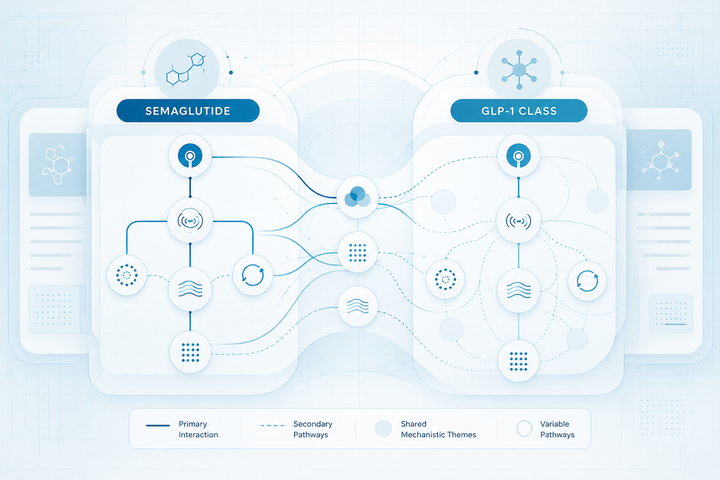
Semaglutide vs GLP-1 Class: Mechanistic Comparison Framework
Class comparison

Semaglutide is a peptide-based GLP-1 receptor agonist whose core pharmacology resides within the broader GLP-1 receptor agonist class. A mechanistic comparison therefore starts with shared receptor biology before examining compound-specific molecular features. The framework includes GLP-1 biology, mechanism, receptor occupancy, intracellular signaling, pharmacodynamics, and clinical pharmacology. Class membership establishes a common pharmacological target but does not eliminate differences in molecular structure, exposure, or signaling kinetics.

GLP-1 receptor agonists can differ in peptide sequence, chemical modification, proteolytic stability, albumin association, receptor interaction, distribution, and elimination. These properties influence the concentration-time profile and therefore the temporal pattern of receptor stimulation. Comparative interpretation connects pharmacokinetics, pharmacodynamics, mechanism, GLP-1 biology, and clinical pharmacology while maintaining a distinction between class-shared receptor effects and compound-specific exposure characteristics.

At the physiological level, GLP-1 receptor activation intersects with pancreatic hormone secretion, gastrointestinal motor regulation, neural appetite pathways, and glucose metabolism. These systems are linked through glycemic control, glycemic variability, appetite regulation, insulin resistance, and metabolic outcomes. Mechanistic comparison asks how a shared receptor pathway is translated through different molecular and exposure contexts rather than assuming identical downstream dynamics across every agent.

Comparison layer Shared class feature Compound-specific variable
Target GLP-1 receptor Ligand-receptor interaction
Signal transduction cAMP-associated signaling Signal duration and receptor dynamics
Exposure-response GLP-1 receptor-mediated PD Molecular PK profile

GLP-1 Receptor Biology Across Agents

The GLP-1 receptor is a class B1 G protein-coupled receptor expressed across tissues involved in endocrine and metabolic regulation. Activation can stimulate Gs-associated adenylyl cyclase activity, increasing intracellular cyclic AMP and engaging protein kinase A and exchange protein directly activated by cAMP pathways. This biology forms the basis of GLP-1 biology, mechanism, pharmacodynamics, clinical pharmacology, and downstream endocrine signaling.

Different GLP-1 receptor agonists can engage the same receptor while differing in affinity, residence characteristics, molecular conformation, proteolytic stability, and exposure duration. Receptor activation can also involve beta-arrestin recruitment, receptor internalization, trafficking, and signal attenuation, although the magnitude and temporal behavior depend on ligand-receptor context. These concepts connect pharmacokinetics, pharmacodynamics, mechanism, GLP-1 biology, and clinical pharmacology.

Receptor-level comparison should also distinguish pharmacological activation from endogenous GLP-1 physiology. Native GLP-1 has rapid enzymatic degradation and transient signaling, whereas therapeutic agonists are structurally modified to alter exposure and pharmacological persistence. Consequently, class comparisons require attention to pharmacokinetics, pharmacodynamics, glycemic control, appetite regulation, and metabolic outcomes without treating endogenous and pharmacological signaling as equivalent.

Receptor feature Mechanistic description Comparative variable
GLP-1 receptor Class B1 GPCR Ligand affinity and receptor interaction
Primary signaling Gs-associated cAMP generation Signal amplitude and duration
Receptor regulation Internalization and desensitization Ligand-specific receptor dynamics

PK/PD Comparison Across GLP-1 Agonists

PK/PD interpretation distinguishes what the body does to an agent from what the agent does to biological systems. For GLP-1 receptor agonists, absorption, distribution, metabolism, elimination, molecular stability, and protein association shape systemic exposure, while receptor affinity and downstream signaling shape pharmacodynamics. The integrated framework uses pharmacokinetics, pharmacodynamics, clinical pharmacology, mechanism, and GLP-1 biology.

Semaglutide has molecular modifications that increase resistance to enzymatic degradation and support prolonged systemic exposure. Other GLP-1 receptor agonists use different structural strategies, producing different exposure profiles and temporal relationships between circulating concentrations and receptor activation. Comparative interpretation therefore considers concentration-time behavior, receptor occupancy, intrinsic activity, signal transduction, and physiological adaptation. Relevant downstream domains include glycemic control, glycemic variability, appetite regulation, metabolic outcomes, and pharmacodynamics.

PK/PD comparisons can also reveal why agents sharing a molecular target may generate different temporal patterns of receptor stimulation. Tissue exposure may not exactly mirror plasma exposure, and biological response can involve nonlinear relationships, receptor reserve, feedback regulation, and delayed physiological effects. Interpretation should therefore integrate pharmacokinetics, pharmacodynamics, clinical pharmacology, clinical trials, and effectiveness overview without reducing pharmacology to circulating concentration alone.

PK/PD domain Mechanistic question Comparison relevance
Exposure How does concentration change over time? Duration of receptor availability
Receptor response How does exposure generate GLP-1 signaling? Affinity, occupancy and signal transduction
Integrated PD How does signaling translate into physiology? Endocrine, GI, appetite and metabolic pathways

Endocrine-Linked Comparison Pathways

GLP-1 receptor activation in pancreatic islet cells can amplify glucose-dependent insulin secretion through cyclic AMP-linked intracellular signaling. GLP-1 receptor agonists therefore share a fundamental endocrine mechanism, while differences in exposure and receptor interaction can alter the temporal pattern of signaling. Relevant interpretive domains include GLP-1 biology, mechanism, glycemic control, pharmacodynamics, and clinical pharmacology.

GLP-1 receptor signaling can also influence glucagon physiology, particularly through interactions among alpha-cell signaling, ambient glucose, insulin, somatostatin, and paracrine islet communication. The endocrine response is therefore context dependent rather than a single direct receptor-output relationship. Comparison can incorporate glycemic variability, insulin resistance, type 2 diabetes, prediabetes, and metabolic outcomes as physiological contexts.

Endocrine interpretation also requires separation of direct pancreatic signaling from secondary effects mediated by altered nutrient delivery, gastrointestinal physiology, appetite, and energy balance. A measured change in insulin or glucagon can consequently reflect several interacting pathways. Mechanistic analysis can integrate pharmacokinetics, pharmacodynamics, glycemic control, clinical trials, and clinical pharmacology while retaining the distinction between receptor-level activity and whole-body endocrine physiology.

Endocrine pathway GLP-1-linked mechanism Interpretive variable
Beta cell cAMP-amplified glucose-dependent insulin secretion Glucose and receptor context
Alpha cell Modulation of glucagon physiology Ambient glucose and paracrine signaling
Islet network Coordinated insulin, glucagon and somatostatin signaling Integrated endocrine state

Gastrointestinal-Linked Comparison Pathways

GLP-1 receptor signaling is connected to gastrointestinal physiology through enteric, vagal, and central pathways that influence gastric motor activity and nutrient delivery. Across the GLP-1 receptor agonist class, these mechanisms provide a shared biological framework, while molecular exposure characteristics influence temporal signaling. Relevant concepts include GLP-1 biology, mechanism, pharmacodynamics, clinical pharmacology, and appetite regulation.

Gastrointestinal effects cannot be interpreted solely as direct receptor activity because gastric emptying and nutrient transit interact with vagal signaling, gastric distension, intestinal nutrient sensing, and postprandial endocrine feedback. Differences among agents may therefore reflect exposure, receptor activation, physiological adaptation, or measurement timing. These relationships connect pharmacokinetics, glycemic control, glycemic variability, mechanism, and metabolic outcomes.

Temporal gastrointestinal interpretation is particularly relevant because gastric motor responses can vary according to nutritional state, receptor stimulation, neural adaptation, and exposure history. The resulting physiological signal may influence downstream glucose and appetite pathways without being equivalent to a direct measurement of receptor occupancy. Comparative evidence can therefore be examined alongside pharmacokinetics, pharmacodynamics, obesity, weight management, and clinical trials.

GI component Mechanistic pathway Comparison variable
Gastric motor function GLP-1-linked neural and gastrointestinal signaling Exposure and temporal adaptation
Nutrient transit Altered gastric and intestinal signaling Postprandial physiological context
Gut-brain communication Vagal and central pathways Integration with appetite signaling

Appetite-Linked Comparison Pathways

Appetite regulation involves a distributed network connecting gastrointestinal nutrient sensing with vagal afferents, brainstem nuclei, hypothalamic circuits, and other central neural pathways. GLP-1 receptor agonists engage this broader signaling network, with semaglutide representing one pharmacological implementation of sustained GLP-1 receptor activation. Relevant concepts include appetite regulation, GLP-1 biology, mechanism, pharmacodynamics, and clinical pharmacology.

Appetite-related signaling may reflect both peripheral and central receptor mechanisms, together with secondary changes in gastric distension, nutrient delivery, insulin, glucagon, and metabolic state. Comparing GLP-1 receptor agonists therefore requires attention to receptor distribution, exposure, signal duration, neural integration, and physiological context. These dimensions connect pharmacokinetics, metabolic outcomes, obesity, weight management, and appetite regulation.

Measured appetite endpoints can differ according to assessment method, timing, nutritional state, sensory environment, endogenous signaling, and neural adaptation. Consequently, an appetite observation should not be treated as a direct surrogate for receptor activation. Mechanistic interpretation can integrate pharmacodynamics, pharmacokinetics, glycemic variability, insulin resistance, and clinical trials to distinguish receptor-level mechanisms from integrated behavioral and metabolic responses.

Appetite domain Mechanistic components Interpretive context
Peripheral sensing Gut, nutrient and vagal signaling GLP-1 receptor activation
Central integration Brainstem and hypothalamic pathways Neural receptor context
Systems response Endocrine, GI and metabolic feedback Exposure and physiological state

Metabolic-Linked Comparison Pathways

GLP-1 receptor agonism intersects with metabolic regulation through pancreatic hormone signaling, hepatic glucose production, peripheral glucose handling, nutrient flux, and energy balance. Semaglutide shares this fundamental GLP-1 receptor framework with the class, while molecular and exposure differences can alter temporal pharmacodynamics. Relevant metabolic concepts include insulin resistance, glycemic control, metabolic outcomes, GLP-1 biology, and mechanism.

Metabolic physiology represents an integrated response rather than an isolated receptor event. Changes in insulin and glucagon can influence hepatic glucose flux, while gastrointestinal signaling modifies nutrient delivery and appetite pathways influence energy intake. Comparative interpretation therefore connects glycemic variability, appetite regulation, insulin resistance, type 2 diabetes, and prediabetes.

Differences in measured metabolic endpoints may reflect baseline insulin sensitivity, endogenous incretin activity, nutritional state, hepatic physiology, receptor expression, drug exposure, and downstream adaptation. A mechanistic comparison therefore separates shared GLP-1 receptor signaling from contextual variables that modify physiological output. Evidence can be integrated through pharmacokinetics, pharmacodynamics, clinical pharmacology, clinical trials, and effectiveness overview without converting endpoints into treatment recommendations.

Metabolic domain Relevant GLP-1 pathway Interpretive variable
Hepatic glucose regulation Insulin and glucagon-linked signaling Endocrine and nutritional state
Peripheral glucose handling Indirect interaction with insulin-sensitive tissues Insulin sensitivity
Energy regulation Appetite and nutrient signaling Integrated physiological context

Variability in Semaglutide vs GLP-1 Class Response

Mechanistic response variability can arise even when different agents engage the same GLP-1 receptor. Molecular structure, systemic exposure, receptor affinity, tissue distribution, receptor expression, intracellular signaling capacity, and physiological state can all contribute. Comparative analysis therefore integrates pharmacokinetics, pharmacodynamics, GLP-1 biology, mechanism, and clinical pharmacology rather than attributing variability to one factor.

Physiological heterogeneity includes differences in insulin sensitivity, endogenous GLP-1 signaling, gastric motor function, autonomic activity, receptor abundance, central neural circuitry, and metabolic state. These variables can modify downstream signaling without changing the identity of the pharmacological target. Relevant contextual domains include insulin resistance, glycemic variability, appetite regulation, metabolic outcomes, and obesity.

Apparent differences in mechanistic response can also depend on experimental methodology. Sampling time, biomarker selection, receptor assays, physiological endpoints, population characteristics, and study duration influence how a pharmacodynamic relationship is observed. Consequently, comparative interpretation benefits from integrating clinical trials, effectiveness overview, pharmacokinetics, pharmacodynamics, and clinical pharmacology while distinguishing measurement variability from genuine biological heterogeneity.

Variability source Potential mechanism Evidence layer
PK variability Different exposure profiles Pharmacokinetics
Receptor variability Differences in receptor abundance or signaling Pharmacodynamics
Physiological variability Differences in endocrine, GI or metabolic state Systems physiology

Glycemic Endpoint Interpretation Across GLP-1 Agents

Glycemic measurements are downstream indicators of integrated glucose-regulating physiology rather than direct measurements of GLP-1 receptor activation. Insulin secretion, glucagon regulation, gastric nutrient delivery, hepatic glucose production, peripheral glucose utilization, and insulin sensitivity can all contribute. Mechanistic interpretation therefore connects glycemic control, glycemic variability, GLP-1 biology, mechanism, and insulin resistance.

Comparisons among semaglutide and other GLP-1 receptor agonists should distinguish receptor-mediated pharmacodynamics from secondary systems effects. A postprandial glucose measurement, for example, can reflect endocrine signaling together with gastric emptying and nutrient absorption. The interpretation can therefore incorporate pharmacodynamics, pharmacokinetics, clinical pharmacology, type 2 diabetes, and prediabetes as physiological contexts.

Glycemic variability adds a temporal dimension because glucose excursions depend on meals, nutrient absorption, insulin secretion, glucagon physiology, hepatic glucose production, and peripheral glucose disposal. Comparative mechanistic evidence can therefore examine patterns rather than isolated values. Relevant evidence domains include glycemic variability, glycemic control, clinical trials, metabolic outcomes, and effectiveness overview.

Glycemic measure Mechanistic contributors Interpretive layer
Fasting glucose Hepatic glucose production and endocrine regulation Integrated metabolic physiology
Postprandial glucose Insulin, glucagon, gastric emptying and nutrient flux Meal-related pharmacodynamics
Glycemic variability Dynamic interaction of multiple glucose pathways Temporal systems response

Multi-System Integration and Mechanistic Evidence

A complete semaglutide-versus-GLP-1-class interpretation links molecular receptor pharmacology with endocrine, gastrointestinal, neural, and metabolic systems. Semaglutide shares the defining GLP-1 receptor target of the class, while its molecular structure establishes a particular exposure profile. The framework therefore integrates GLP-1 biology, mechanism, pharmacokinetics, pharmacodynamics, and clinical pharmacology.

At the organ-system level, GLP-1 receptor signaling connects pancreatic hormone regulation with gastrointestinal motor pathways, gut-brain communication, appetite circuitry, and metabolic homeostasis. These pathways influence one another through feedback loops and changes in nutrient availability. Relevant integrative domains include glycemic control, appetite regulation, insulin resistance, glycemic variability, and metabolic outcomes.

Mechanistic evidence should be interpreted according to the question each evidence type can answer. Molecular studies describe receptor interaction and signaling, PK/PD studies connect exposure with biological activity, translational studies connect pathways with organ physiology, and clinical research observes integrated responses in defined populations. These layers can be considered alongside clinical trials, effectiveness overview, type 2 diabetes, obesity, and weight management without treating any single endpoint as a complete mechanistic explanation.

Evidence level Primary question Systems connection
Molecular pharmacology How does the ligand engage GLP-1 receptor signaling? Cellular signal transduction
PK/PD How does exposure relate to receptor-mediated activity? Temporal pharmacological response
Clinical physiology How are pathways expressed in integrated systems? Endocrine, GI, appetite and metabolic physiology

Frequently Asked Questions

Semaglutide is itself a GLP-1 receptor agonist, so the comparison is primarily between one molecular implementation of GLP-1 receptor pharmacology and the broader class. The mechanistic framework examines shared receptor signaling alongside differences in molecular structure, receptor interaction, exposure, distribution, elimination, and pharmacodynamic timing. It also considers how receptor activation propagates through endocrine, gastrointestinal, appetite, neural, and metabolic systems. Class membership establishes a common target but does not imply identical pharmacokinetic or pharmacodynamic characteristics across agents.

GLP-1 receptor agonists share the same principal receptor target, a class B1 G protein-coupled receptor, but individual ligands can differ in molecular structure, receptor affinity, conformational effects, stability, and signaling kinetics. Receptor activation commonly involves cyclic AMP-associated pathways, with downstream effects influenced by cellular context, receptor density, trafficking, and intracellular signaling capacity. Consequently, comparing agents requires separating the common receptor mechanism from compound-specific ligand-receptor behavior and the exposure profile that determines the temporal pattern of receptor engagement.

Pharmacokinetics describes systemic exposure over time, whereas pharmacodynamics describes the biological response associated with receptor activation. GLP-1 receptor agonists can have different molecular structures that alter stability, distribution, metabolism, elimination, and therefore concentration-time behavior. These differences can influence the temporal relationship between circulating exposure and receptor signaling. PK/PD comparison consequently helps distinguish mechanisms related to molecular exposure from mechanisms related to receptor affinity, occupancy, intrinsic activity, downstream signal amplification, receptor regulation, or physiological adaptation.

The principal endocrine framework involves pancreatic islet signaling, particularly glucose-dependent insulin secretion and regulation of glucagon physiology. GLP-1 receptor activation can increase cyclic AMP signaling in relevant endocrine cells and modify secretory processes in a glucose- and tissue-dependent context. The observed endocrine response can also be influenced by paracrine islet communication, nutrient availability, insulin sensitivity, and gastrointestinal signaling. Comparative interpretation therefore distinguishes direct receptor-mediated signaling from secondary endocrine effects produced by broader metabolic and physiological feedback.

Gastrointestinal mechanisms include interactions with gastric motor function, nutrient delivery, enteric signaling, vagal afferents, and gut-brain communication. GLP-1 receptor activation participates in these pathways, while the temporal pattern of pharmacological receptor stimulation can vary among agonists because of different exposure characteristics. Gastrointestinal observations may also be secondary to changes in nutrient transit, gastric distension, endocrine feedback, and neural signaling. Consequently, GI-related measurements should be interpreted as integrated physiological signals rather than isolated indicators of receptor activation.

Appetite regulation involves interconnected peripheral and central pathways, including gastrointestinal nutrient sensing, vagal afferents, brainstem circuits, hypothalamic networks, and other neural systems. GLP-1 receptor activation participates in this network, while differences among agonists can arise from exposure duration, receptor engagement, tissue distribution, and physiological context. Appetite measurements can also be affected by gastric distension, nutrient delivery, endocrine feedback, and metabolic state. Thus, appetite-related observations represent integrated neural and physiological responses rather than direct measurements of receptor occupancy.

Relevant metabolic pathways include insulin and glucagon signaling, hepatic glucose production, peripheral glucose handling, nutrient flux, and energy regulation. GLP-1 receptor activation influences these systems through endocrine and gastrointestinal mechanisms, while molecular differences among agonists can alter exposure and signaling timing. Metabolic measurements therefore reflect coordinated activity across several tissues rather than one receptor event. Mechanistic interpretation considers receptor pharmacology, insulin sensitivity, nutritional state, endogenous incretin physiology, pharmacokinetics, pharmacodynamics, and downstream feedback among metabolic organs.

Mechanistic variability can result from differences in molecular exposure, receptor interaction, tissue distribution, receptor expression, intracellular signaling, endogenous GLP-1 physiology, insulin sensitivity, gastrointestinal function, and neural circuitry. Experimental conditions can introduce additional variation through sampling time, assay selection, endpoint definition, and population characteristics. Because these variables interact, an observed difference between agents cannot automatically be attributed to a single pharmacological property. Comparative analysis therefore separates PK variation, receptor-level pharmacology, physiological state, and measurement-related variation.

Glycemic endpoints are downstream indicators of multiple interacting glucose-regulating mechanisms. Insulin secretion, glucagon physiology, gastric nutrient delivery, hepatic glucose production, peripheral glucose utilization, and insulin sensitivity can all influence measured glucose concentrations. A glycemic endpoint therefore does not directly identify the magnitude of receptor activation. Mechanistic interpretation is more specific when glucose measurements are considered alongside receptor pharmacology, hormone concentrations, pharmacokinetic exposure, pharmacodynamic measures, gastrointestinal physiology, and other indicators of integrated glucose regulation.

Metabolic endpoints reflect coordinated activity across pancreatic, hepatic, adipose, skeletal muscle, gastrointestinal, and neural systems. Differences in a metabolic measurement may therefore arise from receptor signaling, exposure characteristics, insulin sensitivity, nutrient intake, endogenous hormone physiology, or downstream adaptation. A single endpoint does not establish which pathway produced the observed signal. Mechanistic comparison separates direct GLP-1 receptor effects from secondary systemic responses and considers temporal exposure, physiological state, tissue-specific signaling, and feedback among endocrine and metabolic systems.

Appetite endpoints reflect a complex network involving peripheral nutrient sensing, gastric and intestinal signals, vagal pathways, brainstem circuits, hypothalamic regulation, and other central neural processes. GLP-1 receptor signaling contributes to this network, but an appetite measurement is not equivalent to direct receptor activation. The observed signal can also depend on exposure timing, nutritional state, gastric distension, endocrine feedback, metabolic state, and neural adaptation. Mechanistic interpretation therefore treats appetite as an integrated physiological output rather than a single-pathway biomarker.

Mechanistic evidence clarifies the sequence connecting molecular pharmacology with physiological signaling. Receptor studies characterize ligand interaction and intracellular pathways, PK/PD studies connect exposure with biological activity, translational research examines organ-level physiology, and clinical studies observe integrated responses in defined populations. These evidence layers answer different questions and have different interpretive limitations. A robust comparison therefore distinguishes class-shared GLP-1 receptor mechanisms from compound-specific molecular properties, exposure patterns, physiological context, and downstream endpoints.