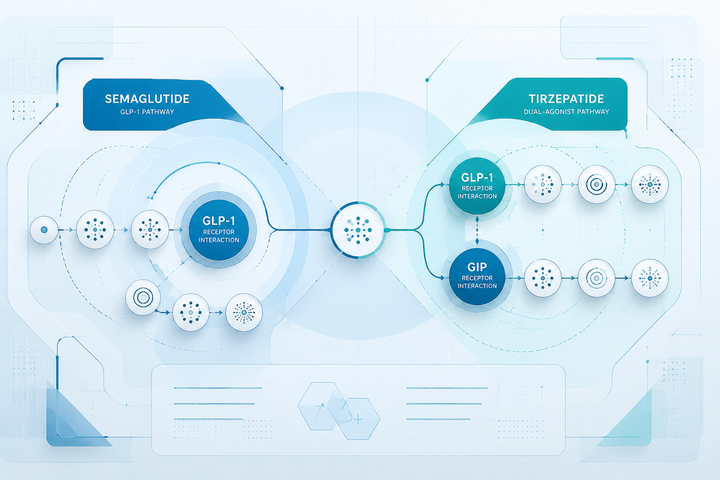
Semaglutide versus tirzepatide can be interpreted mechanistically by distinguishing their receptor pharmacology, exposure-response relationships, and downstream physiological signaling. Semaglutide is characterized by GLP-1 receptor activity, whereas tirzepatide engages both GIP and GLP-1 receptor pathways. Relevant frameworks include GLP-1 biology, mechanism, pharmacokinetics, and pharmacodynamics for describing these pathways without making comparative outcome claims.
The comparison also involves endocrine, gastrointestinal, appetite, and metabolic systems. Receptor activation can be examined alongside insulin and glucagon regulation, gastrointestinal signaling, neural appetite pathways, glucose homeostasis, and energy metabolism. Concepts from clinical pharmacology, insulin resistance, glycemic control, glycemic variability, and appetite regulation help organize the biological relationships without converting them into treatment recommendations.
A systems comparison places receptor pharmacology upstream of physiological endpoints and recognizes that multiple pathways contribute to observed measurements. Contexts such as metabolic outcomes, type 2 diabetes, obesity, clinical trials, and effectiveness overview can provide evidence settings while preserving a neutral distinction between mechanistic pathway differences and clinical outcome interpretation.
A mechanistic comparison begins with receptor target architecture. Semaglutide is a GLP-1 receptor agonist, whereas tirzepatide is a peptide pharmacology construct with activity at both GIP and GLP-1 receptors. This distinction changes the conceptual signaling network while retaining shared GLP-1-associated biology. Relevant foundations include GLP-1 biology, mechanism, pharmacokinetics, pharmacodynamics, and clinical pharmacology. The comparison therefore concerns receptor-level pathway architecture rather than a simple ranking of agents.
At the endocrine level, both pharmacological frameworks can be examined through pancreatic islet signaling, glucose-dependent insulin secretion, glucagon regulation, and broader neuroendocrine communication. Tirzepatide introduces GIP receptor biology into the comparison, creating an additional receptor pathway alongside GLP-1 signaling. These mechanisms intersect with insulin resistance, glycemic control, glycemic variability, type 2 diabetes, and prediabetes as physiological contexts.
The comparison is broader than receptor identity because downstream signaling operates across gastrointestinal, neural, endocrine, and metabolic systems. Appetite regulation, nutrient handling, and energy balance can be considered alongside receptor pharmacology and exposure. Relevant domains include appetite regulation, metabolic outcomes, obesity, weight management, and clinical trials. A mechanistic framework keeps these domains connected while avoiding assumptions that pathway differences necessarily establish comparative clinical outcomes.
| Agent | Primary receptor framework | Mechanistic interpretation |
|---|---|---|
| Semaglutide | GLP-1 receptor | GLP-1-centered receptor signaling |
| Tirzepatide | GIP and GLP-1 receptors | Dual incretin receptor signaling |
| Both | Peptide receptor pharmacology | Exposure-dependent pharmacodynamic pathways |
GLP-1 receptor biology provides a shared mechanistic foundation for semaglutide and tirzepatide, while tirzepatide additionally engages GIP receptor signaling. GLP-1 receptor activation involves G-protein-coupled receptor signaling and downstream intracellular pathways relevant to pancreatic and neural physiology. The comparison can be framed through GLP-1 biology, mechanism, pharmacodynamics, clinical pharmacology, and pharmacokinetics without inferring clinical superiority.
GIP receptor biology adds another incretin signaling dimension, with receptor expression and physiological context differing across tissues and metabolic states. The combined pathway architecture can therefore be studied as an interaction between receptor-specific signaling systems rather than as a single generalized incretin effect. Relevant metabolic domains include insulin resistance, glycemic control, metabolic outcomes, type 2 diabetes, and obesity.
Mechanistic interpretation also requires attention to receptor distribution, ligand exposure, intracellular signaling, feedback, and tissue-specific physiology. Shared GLP-1 pathways can be distinguished from additional GIP-linked signaling when examining endocrine, gastrointestinal, appetite, and metabolic systems. Evidence from clinical trials, glycemic variability, appetite regulation, weight management, and effectiveness overview should be interpreted according to the biological endpoint represented.
| Pathway | Receptor biology | Principal mechanistic domain |
|---|---|---|
| GLP-1 | GLP-1 receptor signaling | Endocrine, neural, gastrointestinal pathways |
| GIP | GIP receptor signaling | Incretin and metabolic signaling |
| Dual pathway | GIP plus GLP-1 receptor activity | Integrated incretin pharmacology |
Pharmacokinetic comparison examines how semaglutide and tirzepatide enter and persist within systemic compartments, including absorption, distribution, metabolism, and elimination. These processes establish concentration-time relationships that precede pharmacodynamic interpretation. Concepts from pharmacokinetics, pharmacodynamics, clinical pharmacology, mechanism, and GLP-1 biology provide a structured framework for distinguishing exposure from receptor-mediated effects.
Pharmacodynamic comparison then considers receptor occupancy, signaling intensity, tissue responsiveness, and downstream physiological coupling. Semaglutide-associated GLP-1 receptor activity can be compared conceptually with tirzepatide's combined GLP-1 and GIP receptor pharmacology. These pathways connect with glycemic control, glycemic variability, insulin resistance, appetite regulation, and metabolic outcomes without translating exposure differences into outcome claims.
Exposure-response interpretation must distinguish pharmacokinetic variability from pharmacodynamic variability and from physiological or measurement variability. A comparison can therefore ask whether differences arise from concentration, receptor activity, downstream signaling, biological state, or endpoint definition. Evidence from clinical trials, type 2 diabetes, obesity, prediabetes, and effectiveness overview can be organized around these mechanistic layers.
| PK/PD layer | Semaglutide interpretation | Tirzepatide interpretation |
|---|---|---|
| Exposure | Systemic semaglutide concentration | Systemic tirzepatide concentration |
| Receptor activity | GLP-1 receptor pharmacodynamics | GLP-1 and GIP receptor pharmacodynamics |
| Response | Downstream GLP-1-linked physiology | Integrated incretin-linked physiology |
Endocrine comparison centers on pancreatic islet signaling and the role of incretin receptors in glucose-dependent insulin secretion and glucagon regulation. Semaglutide primarily engages GLP-1 receptor biology, while tirzepatide adds GIP receptor signaling to its pharmacological architecture. These pathways can be interpreted through GLP-1 biology, mechanism, pharmacodynamics, clinical pharmacology, and insulin resistance as distinct mechanistic domains.
Endocrine signaling is integrated with hepatic glucose production, peripheral glucose uptake, pancreatic beta-cell signaling, alpha-cell regulation, and nutrient-dependent feedback. These processes provide context for glycemic control, glycemic variability, type 2 diabetes, prediabetes, and metabolic outcomes. Mechanistic comparison should distinguish receptor-specific biology from downstream physiological measurements rather than assuming that shared endocrine pathways produce identical responses.
The endocrine comparison also depends on tissue distribution, receptor coupling, ligand concentration, signaling duration, and physiological state. Semaglutide and tirzepatide can therefore be represented as pharmacologically related but mechanistically distinct incretin systems. Evidence from clinical trials, pharmacokinetics, pharmacodynamics, appetite regulation, and obesity can be mapped onto these endocrine pathways without making comparative clinical claims.
| Endocrine feature | Semaglutide | Tirzepatide |
|---|---|---|
| GLP-1 receptor | Primary pharmacological target | One pharmacological target |
| GIP receptor | Not the primary target | Additional pharmacological target |
| Islet signaling | GLP-1-mediated pathways | GLP-1 and GIP-mediated pathways |
Gastrointestinal comparison examines how incretin receptor signaling intersects with gastric motility, nutrient sensing, enteric signaling, and gut-brain communication. Semaglutide-associated GLP-1 signaling provides one mechanistic pathway, while tirzepatide introduces additional GIP receptor pharmacology. Relevant frameworks include GLP-1 biology, mechanism, pharmacokinetics, pharmacodynamics, and clinical pharmacology for connecting exposure with gastrointestinal physiology.
Gastrointestinal pathways interact with nutrient transit, visceral signaling, gastric motor function, endocrine feedback, and central appetite networks. These processes can be interpreted alongside appetite regulation, glycemic control, glycemic variability, obesity, and weight management. The mechanistic distinction is between receptor-mediated physiology and the clinical endpoints or observations used to characterize that physiology.
Gastrointestinal variability can reflect baseline motility, nutrient composition, autonomic signaling, endocrine state, receptor sensitivity, and timing of physiological measurement. Comparative interpretation therefore benefits from separating exposure from tissue response and from measured gastrointestinal variables. Relevant evidence includes clinical trials, metabolic outcomes, type 2 diabetes, prediabetes, and effectiveness overview while avoiding claims about comparative tolerability or outcomes.
| GI pathway | Mechanistic feature | Comparison focus |
|---|---|---|
| Gastric signaling | GLP-1-linked gastrointestinal physiology | Receptor pathway context |
| Incretin signaling | GLP-1 with or without GIP activity | Receptor architecture |
| Gut-brain communication | Enteric, vagal, and neural signaling | Integrated appetite physiology |
Appetite-related comparison involves central and peripheral pathways that integrate hormonal, gastrointestinal, and neural signals. Semaglutide-associated GLP-1 receptor activity can be considered alongside tirzepatide's combined GLP-1 and GIP receptor pharmacology. The relevant framework includes appetite regulation, GLP-1 biology, mechanism, pharmacodynamics, and pharmacokinetics without equating receptor differences with a particular behavioral outcome.
Central appetite pathways involve hypothalamic and brainstem circuits, while peripheral signals arise from the gastrointestinal tract, pancreas, and nutrient-sensing systems. These networks intersect with obesity, weight management, insulin resistance, metabolic outcomes, and glycemic control. Mechanistic comparison therefore considers receptor signaling as one component within a distributed energy-regulation network.
Appetite endpoint variability may reflect differences in neural state, endocrine signaling, gastrointestinal physiology, baseline energy balance, measurement methods, and temporal sampling. Comparative interpretation can use clinical pharmacology, clinical trials, type 2 diabetes, prediabetes, and glycemic variability to establish context. These evidence layers describe mechanisms and observations rather than establishing comparative appetite effects.
| Appetite system | Semaglutide pathway | Tirzepatide pathway |
|---|---|---|
| Central signaling | GLP-1 receptor-linked neural pathways | GLP-1 and GIP-linked pathways |
| Peripheral signaling | Gut, endocrine, and vagal inputs | Gut, endocrine, and incretin inputs |
| Energy regulation | Integrated GLP-1 physiology | Integrated dual-incretin physiology |
Metabolic comparison connects incretin receptor pharmacology with glucose flux, insulin signaling, glucagon regulation, hepatic metabolism, nutrient handling, and energy balance. Semaglutide and tirzepatide share GLP-1-related pharmacology but differ in receptor architecture because tirzepatide also engages GIP receptors. Relevant concepts include insulin resistance, glycemic control, metabolic outcomes, GLP-1 biology, and mechanism.
Metabolic pathways are coupled to endocrine signaling, gastrointestinal nutrient processing, appetite regulation, and peripheral tissue physiology. These relationships provide context for glycemic variability, type 2 diabetes, prediabetes, obesity, and weight management. Mechanistic interpretation should identify which receptor pathway, physiological compartment, or endpoint is being examined rather than treating broad metabolic measurements as direct indicators of receptor pharmacology.
Metabolic variability may arise from differences in insulin sensitivity, hepatic glucose regulation, pancreatic function, energy balance, nutrient availability, and tissue-specific signaling. Comparative evidence can therefore be organized through pharmacokinetics, pharmacodynamics, clinical pharmacology, clinical trials, and effectiveness overview. This framework distinguishes biological mechanisms from measured endpoints and avoids interpreting physiological variation as proof of comparative superiority.
| Metabolic domain | Shared mechanism | Comparative receptor context |
|---|---|---|
| Glucose regulation | Incretin-linked endocrine signaling | GLP-1 versus GLP-1 plus GIP |
| Insulin signaling | Glucose-dependent endocrine pathways | Receptor-specific modulation |
| Energy metabolism | Integrated nutrient and appetite networks | Single versus dual receptor architecture |
Comparative response variability can occur at pharmacokinetic, pharmacodynamic, physiological, and measurement levels. Differences in absorption, systemic exposure, receptor sensitivity, intracellular signaling, endocrine state, and metabolic context can influence how mechanistic observations are represented. Frameworks from pharmacokinetics, pharmacodynamics, clinical pharmacology, mechanism, and GLP-1 biology help separate these sources of variability.
Biological context can modify signaling through differences in insulin resistance, pancreatic function, gastrointestinal physiology, appetite regulation, and energy balance. These dimensions intersect with insulin resistance, glycemic variability, appetite regulation, obesity, and type 2 diabetes. Such variation does not necessarily identify one agent as intrinsically stronger or weaker; it demonstrates that receptor pharmacology operates within heterogeneous biological systems.
Comparative evidence should also distinguish interindividual variability from within-subject variability and mechanistic biomarkers from broader clinical endpoints. Studies involving clinical trials, glycemic control, metabolic outcomes, prediabetes, and weight management can be interpreted according to endpoint type, study design, exposure, and physiological context. This preserves mechanistic neutrality when comparing response distributions.
| Variability source | Mechanistic layer | Comparison relevance |
|---|---|---|
| PK variability | Exposure and concentration-time behavior | Exposure differences |
| PD variability | Receptor signaling and tissue response | Pharmacodynamic differences |
| Physiological variability | Endocrine, GI, appetite, metabolic state | Context-dependent interpretation |
Glycemic endpoints are downstream measurements of glucose physiology and should be distinguished from receptor-level comparison. Semaglutide-associated GLP-1 signaling and tirzepatide-associated GLP-1 plus GIP signaling can influence endocrine pathways involved in glucose homeostasis, but endpoint measurements represent integrated physiology. Relevant concepts include glycemic control, glycemic variability, insulin resistance, pharmacokinetics, and pharmacodynamics.
Glucose measurements can reflect insulin secretion, glucagon regulation, hepatic glucose production, peripheral glucose disposal, nutrient absorption, and temporal metabolic feedback. Consequently, comparison of glycemic endpoints requires attention to the biological layer being measured. Contexts such as type 2 diabetes, prediabetes, clinical pharmacology, clinical trials, and mechanism can help organize evidence without translating endpoint differences into treatment conclusions.
Mechanistic interpretation can distinguish concentration-time behavior, receptor activation, endocrine signaling, and observed glucose dynamics. This separation is important because a glycemic endpoint may integrate several pathways simultaneously and therefore cannot be treated as a direct readout of receptor occupancy. Related domains include metabolic outcomes, appetite regulation, obesity, weight management, and effectiveness overview as contextual rather than prescriptive evidence.
| Glycemic layer | Biological basis | Mechanistic comparison |
|---|---|---|
| Glucose concentration | Integrated glucose homeostasis | Downstream endpoint |
| Glycemic variability | Temporal glucose dynamics | Physiological measurement |
| Exposure-response | PK concentration and receptor signaling | Mechanistic bridge |
Metabolic endpoints encompass glucose regulation, insulin sensitivity, nutrient handling, energy balance, and other integrated physiological variables. A mechanistic comparison places these endpoints downstream of receptor pharmacology and endocrine signaling. Semaglutide and tirzepatide can therefore be examined through mechanism, pharmacokinetics, pharmacodynamics, insulin resistance, and metabolic outcomes without treating endpoint measurements as direct receptor assays.
Metabolic physiology incorporates pancreatic, hepatic, gastrointestinal, neural, and peripheral tissue pathways. These systems interact with glycemic control, glycemic variability, appetite regulation, type 2 diabetes, and obesity. A comparison therefore requires recognition that the same measured endpoint may reflect multiple mechanisms, while receptor-specific differences may operate through several physiological compartments.
Evidence interpretation can distinguish mechanistic biomarkers from composite metabolic measures and can account for timing, exposure, baseline physiology, and measurement methodology. Relevant evidence settings include clinical trials, clinical pharmacology, prediabetes, weight management, and effectiveness overview. These contexts can support mechanistic mapping while avoiding superiority statements, treatment implications, or conclusions about individual response.
| Metabolic endpoint | Underlying biology | Interpretive position |
|---|---|---|
| Insulin sensitivity | Insulin receptor and intracellular signaling | Downstream metabolic variable |
| Glucose homeostasis | Pancreatic, hepatic, and peripheral pathways | Integrated endocrine endpoint |
| Energy balance | Appetite, nutrient sensing, metabolism | Multi-system endpoint |
A systems-level comparison begins with receptor architecture and extends through pharmacokinetic exposure, pharmacodynamic signaling, endocrine regulation, gastrointestinal physiology, appetite pathways, and metabolic networks. Semaglutide provides a GLP-1-centered model, whereas tirzepatide adds GIP receptor signaling. These relationships can be organized using GLP-1 biology, mechanism, pharmacokinetics, pharmacodynamics, and clinical pharmacology.
Endocrine and gastrointestinal systems communicate with neural appetite circuits and metabolic tissues through overlapping hormonal and nutrient-sensing pathways. This integration connects insulin resistance, glycemic control, glycemic variability, appetite regulation, and metabolic outcomes. Mechanistic comparison therefore requires a network perspective rather than interpreting receptor identity, exposure, or any single endpoint in isolation.
Clinical evidence can provide multiple observational layers while remaining distinct from mechanistic inference. Studies involving clinical trials, type 2 diabetes, prediabetes, obesity, weight management, and effectiveness overview can be mapped onto the systems model according to endpoint and study design. This approach preserves the difference between pharmacological mechanism, physiological integration, and observed clinical measurements.
| System level | Semaglutide framework | Tirzepatide framework |
|---|---|---|
| Receptor biology | GLP-1 receptor | GLP-1 plus GIP receptors |
| Endocrine and GI | GLP-1-linked signaling | Dual-incretin-linked signaling |
| Metabolic integration | GLP-1-centered network | GLP-1 and GIP-centered network |
Mechanistically, semaglutide and tirzepatide are related incretin-based peptide pharmacologies with different receptor architectures. Semaglutide primarily activates the GLP-1 receptor, whereas tirzepatide has activity at both GLP-1 and GIP receptors. The comparison therefore concerns receptor biology, intracellular signaling, pharmacokinetics, pharmacodynamics, endocrine regulation, gastrointestinal physiology, appetite networks, and metabolism. It does not inherently establish that one agent is superior. A mechanistic comparison instead asks how receptor targets and exposure-response relationships connect with downstream biological systems and measured physiological variables.
GLP-1-centered biology involves activation of the GLP-1 receptor, a G-protein-coupled receptor involved in pancreatic, neural, gastrointestinal, and metabolic signaling. Dual-agonist biology adds GIP receptor activation to GLP-1 receptor signaling, creating a broader incretin receptor architecture. The biological distinction therefore concerns receptor distribution, ligand-receptor interactions, intracellular signaling, tissue context, and physiological coupling. These mechanisms can overlap substantially while remaining pharmacologically distinguishable. Mechanistic interpretation should describe these pathway differences without converting receptor architecture into claims about comparative clinical outcomes.
Pharmacokinetics describes systemic exposure through processes such as absorption, distribution, metabolism, and elimination, whereas pharmacodynamics describes biological effects associated with receptor signaling and downstream physiology. Comparing these dimensions helps distinguish concentration-time behavior from receptor-mediated response. Semaglutide and tirzepatide can therefore be evaluated according to exposure, receptor engagement, signaling, physiological state, and endpoint timing. Differences observed at a clinical measurement level cannot automatically be assigned to pharmacokinetics or pharmacodynamics without considering the intervening biological pathways and the characteristics of the measurement itself.
The endocrine distinction centers on receptor architecture. Semaglutide provides GLP-1 receptor activity, while tirzepatide combines GLP-1 receptor and GIP receptor activity. Both pathways can participate in incretin-associated regulation of pancreatic islet function, including glucose-dependent insulin secretion and glucagon-related signaling. GIP adds another endocrine signaling dimension that may interact with tissue-specific metabolic physiology. Mechanistic comparison therefore considers receptor expression, ligand exposure, intracellular signaling, pancreatic responses, and systemic feedback. These factors describe biological architecture rather than establishing a comparative clinical advantage.
Gastrointestinal comparison involves pathways associated with incretin receptor signaling, gastric motility, nutrient sensing, enteric communication, and gut-brain signaling. GLP-1-related physiology is relevant to both agents, while tirzepatide additionally introduces GIP receptor biology. Gastrointestinal observations are downstream of receptor pharmacology and can also be influenced by autonomic, endocrine, nutritional, and neural factors. Mechanistic interpretation therefore separates receptor-mediated processes from measured gastrointestinal variables. The comparison does not imply that any particular gastrointestinal measurement directly represents the intrinsic properties of either pharmacological agent.
Appetite regulation is a distributed process involving hypothalamic and brainstem circuits, gastrointestinal signals, vagal communication, pancreatic hormones, nutrient sensing, and broader energy-balance networks. Semaglutide-associated GLP-1 signaling can participate in these pathways, while tirzepatide combines GLP-1 and GIP receptor pharmacology. Mechanistic comparison therefore examines how receptor signaling enters central and peripheral appetite networks rather than treating appetite as a single receptor output. Differences in measured appetite variables may also reflect physiological state, endpoint definition, timing, and biological variability.
Both agents involve incretin-associated metabolic signaling, but their receptor architectures differ. Semaglutide primarily engages GLP-1 receptors, while tirzepatide engages both GLP-1 and GIP receptors. Downstream metabolic pathways can include pancreatic insulin signaling, glucagon regulation, hepatic glucose handling, peripheral glucose utilization, nutrient sensing, and energy balance. The mechanistic comparison therefore concerns how receptor-specific signaling is integrated across tissues. Metabolic measurements are downstream and may represent several pathways simultaneously, so they should not be treated as direct assays of receptor pharmacology.
Variability can arise at several levels, including pharmacokinetic exposure, receptor pharmacodynamics, tissue sensitivity, endocrine state, gastrointestinal physiology, metabolic status, appetite signaling, and endpoint measurement. Individual biological systems also differ in receptor expression, insulin sensitivity, pancreatic function, nutrient handling, and neural regulation. Consequently, an observed difference may reflect several interacting mechanisms rather than a single property of one agent. Mechanistic interpretation separates pharmacokinetic variability from pharmacodynamic and physiological variability, while also considering how study design and measurement methodology influence observed response distributions.
Glycemic endpoints represent downstream measurements of glucose physiology rather than direct measurements of receptor activity. They can reflect insulin secretion, glucagon regulation, hepatic glucose production, peripheral glucose disposal, nutrient handling, and temporal metabolic feedback. Semaglutide-associated GLP-1 signaling and tirzepatide-associated GLP-1 plus GIP signaling can be situated upstream of these processes. Mechanistic comparison therefore requires separating receptor pharmacology, exposure, endocrine signaling, and measured glucose variables. An observed glycemic difference alone does not identify which biological pathway generated the measurement.
Metabolic endpoints may represent glucose regulation, insulin sensitivity, energy balance, nutrient handling, lipid metabolism, or integrated physiological states. Because these variables can incorporate several biological pathways, they are not equivalent to receptor-specific pharmacodynamic measurements. A mechanistic comparison places semaglutide and tirzepatide receptor activity upstream of endocrine and metabolic signaling, then considers how those pathways contribute to the measured endpoint. Interpretation should account for pharmacokinetics, pharmacodynamics, baseline physiology, endpoint definition, temporal sampling, and the degree to which the endpoint integrates multiple biological systems.
Appetite endpoints can reflect subjective perception, meal-related responses, central neural signaling, gastrointestinal communication, endocrine state, or energy-intake regulation. These measurements are downstream of interconnected systems and should therefore be distinguished from receptor architecture. Semaglutide-associated GLP-1 activity and tirzepatide-associated GLP-1 plus GIP activity can be mapped onto appetite-related neural and peripheral pathways, but an endpoint does not provide a simple one-to-one measure of receptor signaling. Mechanistic interpretation should consider biological context, measurement design, timing, and variability.
Mechanistic evidence identifies the biological layer represented by a finding. Receptor studies address pharmacology, pharmacokinetic studies address exposure, pharmacodynamic studies address signaling and physiological response, and clinical studies measure endpoints in defined populations and contexts. Keeping these evidence types distinct helps prevent downstream observations from being interpreted as direct evidence of receptor activity or intrinsic superiority. A rigorous comparison therefore integrates molecular biology, exposure-response relationships, endocrine pathways, gastrointestinal physiology, appetite networks, metabolic regulation, and measured endpoints while preserving uncertainty and distinguishing mechanism from clinical interpretation.