Mechanistic comparison • PK/PD framework

Semaglutide vs Dulaglutide — Mechanistic Comparison Hub

Semaglutide and dulaglutide are long-acting GLP-1 receptor agonists whose mechanistic comparison begins with shared receptor biology rather than with clinical ranking. Their molecular and pharmacological properties can be examined through GLP-1 biology, receptor-linked mechanism, pharmacokinetics, and pharmacodynamics. This framework separates receptor activation from downstream endocrine, gastrointestinal, appetite and metabolic physiology while preserving clinically neutral interpretation.

A comparison also requires attention to how molecular structure, albumin association, proteolytic stability, systemic exposure and receptor engagement influence pharmacodynamic signaling. These dimensions connect clinical pharmacology with pancreatic hormone secretion, gastrointestinal motility, appetite regulation and metabolic signaling. Contexts involving type 2 diabetes, obesity and prediabetes can therefore be interpreted as physiological settings rather than as claims about comparative outcomes.

Semaglutide-versus-dulaglutide interpretation is inherently multidimensional. Receptor signaling, exposure-response relationships, endocrine feedback, gastrointestinal neural pathways and energy-balance circuits operate as interconnected systems. Mechanistic evidence from clinical trials and an effectiveness overview can be considered alongside appetite regulation, glycemic control and metabolic outcomes without converting physiological observations into treatment recommendations or superiority conclusions.

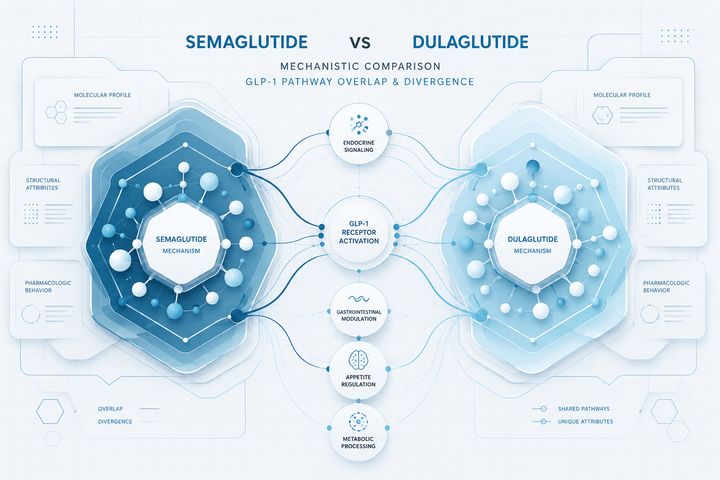
Semaglutide vs Dulaglutide Mechanistic Comparison Framework
Agent comparison

Semaglutide and dulaglutide share the central pharmacological property of GLP-1 receptor agonism, creating a common starting point for mechanistic comparison. The relevant biology extends from receptor activation to intracellular cyclic AMP signaling, glucose-dependent pancreatic responses, gastrointestinal neural pathways and central appetite circuitry. Interpretation therefore connects GLP-1 biology, mechanism, clinical pharmacology, pharmacodynamics, and pharmacokinetics. These domains describe pharmacological processes rather than establishing a hierarchy between the two molecules.

The comparison becomes more granular when molecular architecture and exposure characteristics are considered. Semaglutide is a modified GLP-1 analogue with structural features supporting prolonged systemic persistence, whereas dulaglutide incorporates GLP-1 analogue sequences into a larger fusion-protein architecture that also alters disposition. Such differences affect exposure, distribution and receptor engagement within a broader pharmacokinetics and pharmacodynamics framework. They can subsequently influence interpretation of endocrine and gastrointestinal signaling without implying a predetermined clinical effect.

A systems comparison also separates proximal pharmacology from distal physiology. Receptor activation represents the pharmacological initiating event, while pancreatic islet signaling, gastric motor regulation, vagal afferent activity, hypothalamic circuits and hepatic metabolic responses represent downstream layers. This hierarchy links insulin resistance, glycemic variability, appetite regulation, obesity, and type 2 diabetes to receptor pharmacology while avoiding direct treatment implications.

Mechanistic layer Comparison focus Interpretive role
Molecular Structure and receptor agonism Defines proximal pharmacology
PK/PD Exposure and receptor-response coupling Connects concentration with signaling
Systems Endocrine, GI, appetite and metabolic pathways Maps downstream physiology

GLP-1 Receptor Biology Comparison

The GLP-1 receptor is a class B G protein-coupled receptor expressed across pancreatic and extra-pancreatic tissues, with signaling that prominently involves adenylyl cyclase activation and intracellular cyclic AMP. Both semaglutide and dulaglutide engage this receptor as agonists, making receptor pharmacology a shared mechanistic foundation. Detailed interpretation incorporates GLP-1 biology, mechanism, pharmacodynamics, clinical pharmacology, and insulin resistance while distinguishing receptor activation from downstream physiological context.

At the cellular level, GLP-1 receptor stimulation can increase cyclic AMP-dependent signaling and modulate protein kinase pathways, calcium handling and secretory machinery. In pancreatic beta cells, these processes participate in glucose-dependent insulin secretory signaling, while alpha-cell regulation and islet paracrine interactions provide additional endocrine dimensions. The relevant framework includes glycemic control, glycemic variability, pharmacodynamics, mechanism, and type 2 diabetes as physiological contexts rather than comparative outcome statements.

Receptor biology does not operate independently from ligand exposure. The magnitude and duration of receptor engagement depend on pharmacokinetic behavior, ligand concentration, receptor availability, intracellular signaling competence and tissue-specific regulatory processes. Consequently, semaglutide-versus-dulaglutide interpretation combines pharmacokinetics with pharmacodynamics, GLP-1 biology, clinical pharmacology, appetite regulation, and metabolic outcomes. This layered model prevents receptor agonism from being treated as a single undifferentiated physiological event.

Receptor process Biological component Mechanistic interpretation
Ligand binding GLP-1 receptor Initiates receptor activation
Second-messenger signaling Cyclic AMP and protein kinase pathways Amplifies intracellular signaling
Cellular response Islet secretory machinery Links receptor activity with endocrine physiology

PK/PD Comparison Relevance

Pharmacokinetic comparison examines how semaglutide and dulaglutide are absorbed, distributed, stabilized and eliminated, while pharmacodynamic comparison considers how systemic exposure translates into receptor-mediated biological signaling. Semaglutide incorporates structural modifications that support albumin binding and reduced enzymatic degradation, whereas dulaglutide's fusion-protein design contributes substantially to its disposition profile. These features make pharmacokinetics, pharmacodynamics, mechanism, clinical pharmacology, and GLP-1 biology central interpretive domains.

Exposure-response relationships are shaped by concentration-time behavior, receptor occupancy, signaling duration and tissue sensitivity. A pharmacodynamic endpoint therefore cannot be interpreted solely from a molecular label such as GLP-1 receptor agonist. Relevant variables include systemic exposure, distribution characteristics, receptor engagement, intracellular signaling and physiological feedback. Connections to glycemic control, glycemic variability, appetite regulation, insulin resistance, and metabolic outcomes illustrate how PK/PD relationships extend into multiple biological systems.

Longitudinal exposure also matters because receptor-mediated physiology can reflect sustained signaling rather than an isolated concentration. Modeling concepts such as exposure-response curves, receptor sensitivity, hysteresis and biological feedback can help distinguish direct pharmacodynamic effects from downstream adaptation. The same analytical framework supports interpretation of clinical trials, effectiveness overview, type 2 diabetes, obesity, and prediabetes without converting pharmacological relationships into comparative clinical recommendations.

PK/PD domain Key variable Mechanistic significance
Exposure Concentration-time profile Shapes receptor engagement
Pharmacodynamics Receptor-mediated signaling Connects exposure with biological response
Integration Exposure-response relationship Links PK behavior with physiology

Endocrine-Linked Comparison Pathways

Endocrine interpretation centers on GLP-1 receptor signaling within pancreatic islets and its interaction with glucose-dependent hormone secretion. Receptor activation can facilitate beta-cell insulin secretion when glucose availability supports secretory demand, while alpha-cell glucagon regulation contributes to broader glucose homeostasis. These processes connect GLP-1 biology, mechanism, glycemic control, insulin resistance, and type 2 diabetes. The comparison remains focused on pathway architecture rather than treatment outcomes.

Semaglutide and dulaglutide can therefore be considered within an endocrine network involving beta-cell stimulus-secretion coupling, alpha-cell regulation, hepatic glucose flux and peripheral insulin sensitivity. The resulting physiology reflects both direct receptor signaling and secondary changes in nutrient availability, neural inputs and hormonal feedback. Relevant interpretive domains include pharmacodynamics, clinical pharmacology, glycemic variability, metabolic outcomes, and prediabetes.

Endocrine pathways also interact dynamically with insulin resistance and prevailing metabolic state. Receptor-mediated changes in insulin and glucagon signaling may alter hepatic glucose production, nutrient partitioning and feedback relationships among pancreatic, hepatic and peripheral tissues. Consequently, semaglutide-versus-dulaglutide interpretation incorporates pharmacokinetics, pharmacodynamics, insulin resistance, glycemic control, and glycemic variability as interconnected physiological variables rather than isolated endpoints.

Endocrine pathway Primary signaling context Downstream physiology
Beta-cell signaling GLP-1 receptor and cyclic AMP Glucose-dependent insulin secretion
Alpha-cell regulation GLP-1-linked islet signaling Glucagon modulation
Hepatic integration Insulin-glucagon balance Glucose flux regulation

Gastrointestinal-Linked Comparison Pathways

Gastrointestinal mechanisms are an important component of GLP-1 receptor pharmacology because receptor signaling intersects with gastric motor function, intestinal nutrient handling and vagal afferent pathways. Semaglutide and dulaglutide can therefore be examined through the relationship between receptor activation and gastrointestinal neural circuits. Relevant concepts include GLP-1 biology, mechanism, pharmacodynamics, clinical pharmacology, and pharmacokinetics without assigning comparative clinical outcomes.

Gastric emptying is influenced by coordinated interactions among enteric neural pathways, vagal signaling, smooth muscle activity and nutrient sensing. GLP-1 receptor agonism can alter this physiological network, thereby modifying the temporal relationship between nutrient entry into the small intestine and downstream endocrine signaling. Interpretation connects appetite regulation, glycemic control, glycemic variability, pharmacodynamics, and mechanism while recognizing that gastrointestinal physiology is dynamic and context dependent.

The gastrointestinal system also communicates with the central nervous system through vagal afferents and circulating metabolic signals. This creates a bridge between gastric motor processes, satiation signaling and broader energy-balance regulation. Semaglutide-versus-dulaglutide comparison therefore spans appetite regulation, obesity, weight management, clinical trials, and effectiveness overview as contextual domains. Mechanistic interpretation remains distinct from claims about comparative gastrointestinal or clinical outcomes.

GI component Mechanistic pathway Interpretive connection
Gastric motor function Neural and smooth-muscle regulation Alters gastric transit physiology
Vagal signaling Gut-brain communication Links nutrient sensing with central pathways
Nutrient delivery Gastric and intestinal coordination Intersects with endocrine signaling

Appetite-Linked Comparison Pathways

Appetite regulation involves coordinated signaling among the gastrointestinal tract, vagal afferents, hypothalamic circuits, hindbrain nuclei and higher-order reward networks. GLP-1 receptor agonism intersects with this distributed system rather than acting through a single appetite center. Semaglutide and dulaglutide can therefore be interpreted through appetite regulation, GLP-1 biology, mechanism, pharmacodynamics, and clinical pharmacology as interconnected mechanistic domains.

Central GLP-1 signaling can interact with hypothalamic and brainstem pathways involved in satiation, meal termination and energy-balance sensing. Peripheral signals from the gastrointestinal tract can contribute through vagal and endocrine communication, while reward-related circuits integrate sensory and motivational information. This framework connects pharmacokinetics, pharmacodynamics, appetite regulation, obesity, and weight management without assigning comparative appetite outcomes.

Appetite-linked interpretation is also sensitive to physiological state, nutrient availability, gastrointestinal signaling and adaptive feedback. Differences in exposure or receptor engagement can be examined mechanistically alongside changes in central signaling and peripheral nutrient sensing, but downstream observations remain multifactorial. Relevant context includes metabolic outcomes, insulin resistance, clinical trials, effectiveness overview, and prediabetes as evidence domains rather than treatment implications.

Appetite system Signaling component Mechanistic role
Gut-brain axis Vagal and endocrine signals Communicates nutrient state
Hypothalamic circuits Energy-balance signaling Integrates hunger and satiation inputs
Hindbrain pathways GLP-1-linked neural signaling Contributes to meal-related processing

Metabolic-Linked Comparison Pathways

Metabolic interpretation integrates GLP-1 receptor signaling with pancreatic endocrine activity, hepatic glucose handling, peripheral insulin sensitivity and nutrient partitioning. Semaglutide and dulaglutide share receptor-level pharmacology while their distinct molecular architectures shape exposure characteristics. The resulting framework connects GLP-1 biology, insulin resistance, glycemic control, metabolic outcomes, and clinical pharmacology without presuming downstream comparative effects.

Insulin sensitivity is not a single molecular pathway but an integrated property of liver, skeletal muscle, adipose tissue and endocrine signaling. GLP-1 receptor-mediated endocrine changes can influence this network indirectly through altered glucose flux, nutrient availability and hormonal feedback. Interpretation therefore combines mechanism, pharmacodynamics, glycemic variability, insulin resistance, and type 2 diabetes to describe biological coupling rather than clinical efficacy.

Metabolic physiology also encompasses energy intake, substrate oxidation, adipose signaling and hepatic nutrient processing. These processes interact with appetite circuits and gastrointestinal signals, producing a network in which endocrine and metabolic variables are mutually coupled. Semaglutide-versus-dulaglutide interpretation can therefore incorporate appetite regulation, obesity, weight management, prediabetes, and metabolic outcomes while maintaining a mechanistic distinction between pathway activity and observed endpoints.

Metabolic domain Relevant pathway Systems connection
Glucose handling Insulin, glucagon and hepatic flux Regulates systemic glucose availability
Insulin sensitivity Peripheral and hepatic signaling Links endocrine and metabolic physiology
Energy balance Appetite and nutrient signaling Connects intake with metabolic state

Variability in Mechanistic Response

Mechanistic response variability can arise from differences in exposure, receptor signaling, tissue sensitivity, metabolic state and physiological feedback. Even when two molecules share GLP-1 receptor agonism, observed biological responses can reflect multiple layers of variation. Interpretation therefore incorporates pharmacokinetics, pharmacodynamics, clinical pharmacology, GLP-1 biology, and mechanism. This framework emphasizes biological heterogeneity rather than assigning a fixed response profile to either molecule.

Pharmacokinetic variability may reflect absorption characteristics, distribution, protein binding, degradation and elimination, while pharmacodynamic variability can involve receptor expression, intracellular signaling competence and tissue-specific sensitivity. Metabolic state adds further complexity through differences in glucose regulation and insulin resistance. Relevant domains include insulin resistance, glycemic variability, glycemic control, type 2 diabetes, and prediabetes.

Systems-level variability also arises because endocrine, gastrointestinal and appetite pathways interact. Differences in gastric motor signaling, vagal activity, nutrient sensing, pancreatic feedback and central appetite circuitry can alter the relationship between receptor activation and downstream physiology. Comparative evidence from clinical trials and an effectiveness overview can therefore be interpreted alongside appetite regulation, metabolic outcomes, and obesity without treating population-level observations as deterministic biological rules.

Variability source Mechanistic determinant Interpretive effect
PK variability Absorption, distribution and elimination Changes exposure profile
PD variability Receptor and intracellular sensitivity Changes signaling-response coupling
Physiological variability Metabolic and neural state Modifies downstream pathway behavior

Glycemic Endpoint Interpretation

Glycemic endpoints can be understood mechanistically as downstream expressions of coordinated pancreatic, hepatic and peripheral glucose-regulatory pathways. GLP-1 receptor signaling influences glucose-dependent insulin secretion and interacts with glucagon regulation, gastrointestinal nutrient delivery and neural signaling. Semaglutide-versus-dulaglutide interpretation therefore connects GLP-1 biology, mechanism, glycemic control, glycemic variability, and pharmacodynamics without converting endpoints into comparative efficacy claims.

Changes in circulating glucose reflect the balance among hepatic glucose production, peripheral glucose disposal, intestinal nutrient appearance and pancreatic hormone secretion. GLP-1 receptor agonism participates primarily through endocrine and neural mechanisms, with secondary metabolic effects emerging from altered nutrient flux and hormonal feedback. This connects pharmacokinetics, insulin resistance, clinical pharmacology, type 2 diabetes, and prediabetes as interpretive contexts.

Glycemic variability adds a temporal dimension because glucose excursions depend on meal composition, gastric transit, insulin secretion, glucagon dynamics, hepatic flux and peripheral sensitivity. A comparison of semaglutide and dulaglutide can therefore examine how exposure-response relationships intersect with these pathways. Relevant domains include pharmacodynamics, glycemic variability, glycemic control, clinical trials, and metabolic outcomes while keeping endpoint interpretation mechanistically bounded.

Glycemic domain Underlying pathway Mechanistic interpretation
Insulin secretion Glucose-dependent beta-cell signaling Modulates glucose disposal
Glucagon regulation Islet endocrine signaling Influences hepatic glucose flux
Glucose variability Integrated temporal physiology Reflects multiple interacting pathways

Metabolic Endpoint Interpretation

Metabolic endpoints represent distal observations arising from interconnected endocrine, appetite, gastrointestinal and energy-balance pathways. Their mechanistic interpretation begins with GLP-1 receptor signaling and extends through insulin, glucagon, nutrient sensing and central appetite circuits. Semaglutide-versus-dulaglutide comparison can therefore integrate metabolic outcomes, insulin resistance, appetite regulation, GLP-1 biology, and mechanism without treating distal endpoints as direct receptor effects.

Metabolic state influences how endocrine signals are translated into tissue-level physiology. Hepatic glucose production, skeletal-muscle glucose disposal, adipose nutrient storage, lipid flux and appetite-related energy intake interact continuously. These relationships make pharmacokinetics, pharmacodynamics, glycemic control, glycemic variability, and clinical pharmacology relevant to interpretation. They also demonstrate why a single endpoint cannot represent the full mechanistic architecture.

Metabolic observations may additionally reflect changes in nutrient availability, gastrointestinal signaling and central energy-balance regulation. Accordingly, interpretation can incorporate obesity, weight management, prediabetes, type 2 diabetes, and clinical trials as contextual evidence domains. The mechanistic framework remains descriptive: it maps biological pathways and exposure-response relationships without inferring treatment superiority or clinical decision consequences.

Metabolic endpoint domain Mechanistic contributors Interpretive level
Glucose metabolism Insulin, glucagon and hepatic flux Endocrine-metabolic
Energy balance Appetite and nutrient signaling Neuroendocrine
Insulin sensitivity Peripheral and hepatic pathways Metabolic systems

Multi-System Mechanistic Integration

The most complete comparison treats semaglutide and dulaglutide as pharmacological inputs to a connected biological network. Molecular structure shapes pharmacokinetics, exposure shapes receptor engagement, receptor activation shapes intracellular signaling, and downstream endocrine, gastrointestinal and neural pathways shape integrated physiology. This hierarchy connects pharmacokinetics, pharmacodynamics, GLP-1 biology, mechanism, and clinical pharmacology into one interpretive framework.

Endocrine signaling interacts with gastrointestinal transit, vagal afferent communication, appetite circuitry, hepatic metabolism and peripheral insulin sensitivity. These feedback loops mean that receptor-level activity cannot be isolated completely from physiological context. Integrated interpretation therefore includes appetite regulation, insulin resistance, glycemic control, glycemic variability, and metabolic outcomes while maintaining a distinction between proximal mechanisms and distal observations.

Evidence interpretation adds another layer because experimental systems, pharmacokinetic analyses, receptor studies and clinical trials capture different portions of the biological hierarchy. Mechanistic conclusions are strongest when molecular pharmacology, exposure-response relationships and systems physiology are interpreted together. Relevant contexts include clinical trials, effectiveness overview, type 2 diabetes, obesity, and weight management. This integrated model supports neutral comparison without implying that one molecule is universally superior.

Systems layer Connected mechanisms Integration purpose
Molecular-PK Structure, stability and exposure Defines pharmacological input
Receptor-endocrine GLP-1 receptor and islet signaling Maps proximal biological response
Systems physiology GI, appetite and metabolism Describes downstream integration

Frequently Asked Questions

The mechanistic concept is a comparison of two long-acting GLP-1 receptor agonists across molecular structure, receptor activation, exposure, intracellular signaling and downstream physiology. Both engage the GLP-1 receptor, but their molecular architectures and disposition characteristics differ, creating distinct pharmacokinetic contexts for receptor exposure. Interpretation then extends into pancreatic endocrine signaling, gastrointestinal neural pathways, appetite regulation and metabolic physiology. The comparison is therefore multidimensional and descriptive, rather than a statement that one molecule produces a universally superior biological or clinical effect.

GLP-1 receptor biology provides the shared pharmacological foundation for comparison because both semaglutide and dulaglutide act as GLP-1 receptor agonists. Receptor activation engages intracellular signaling that prominently involves cyclic AMP and downstream protein kinase pathways. In pancreatic islets, these signals participate in glucose-dependent insulin secretion and broader endocrine regulation. Receptor biology also intersects with neural and gastrointestinal pathways. Consequently, comparison requires attention to receptor pharmacology, ligand exposure, signaling duration, tissue context and physiological feedback rather than receptor identity alone.

PK/PD comparison connects molecular properties with biological signaling. Pharmacokinetics describes absorption, distribution, stability, protein association and elimination, while pharmacodynamics describes receptor engagement and downstream response. Semaglutide and dulaglutide have different molecular architectures that influence these disposition characteristics. Their exposure profiles therefore provide an important context for interpreting receptor-mediated physiology. A mechanistic PK/PD framework can examine concentration-response relationships, signaling duration, receptor sensitivity and biological feedback without assuming that any particular pharmacokinetic feature automatically determines a specific clinical outcome.

Endocrine pathways include pancreatic beta-cell insulin secretion, alpha-cell glucagon regulation, islet paracrine signaling and downstream hepatic glucose metabolism. GLP-1 receptor activation can enhance glucose-dependent insulin secretory signaling and participate in regulation of glucagon physiology. These effects interact with prevailing glucose concentration, insulin sensitivity, nutrient availability and hepatic glucose flux. Semaglutide and dulaglutide can therefore be compared mechanistically through endocrine signaling architecture, receptor exposure and feedback relationships. Such analysis describes physiological coupling without establishing comparative treatment effects.

Gastrointestinal pathways are relevant because GLP-1 signaling intersects with gastric motor function, intestinal nutrient sensing and vagal afferent communication. Gastric emptying reflects coordinated neural, muscular and endocrine processes, and GLP-1 receptor activation can influence this network. Gastrointestinal signals also communicate with pancreatic and central pathways, linking nutrient delivery with endocrine and appetite regulation. A mechanistic comparison therefore considers receptor activation, systemic exposure, gastrointestinal signaling and physiological feedback together, rather than treating gastrointestinal physiology as an isolated pharmacological effect.

Appetite regulation involves a distributed gut-brain system incorporating vagal afferents, brainstem nuclei, hypothalamic energy-balance circuits and higher-order reward networks. GLP-1 receptor signaling can interact with these pathways through both peripheral and central mechanisms. Gastrointestinal nutrient sensing, satiation signaling and endocrine feedback provide additional inputs. Semaglutide and dulaglutide can therefore be interpreted according to receptor pharmacology, exposure, neural signaling and metabolic context. This framework describes appetite biology mechanistically without assuming a particular comparative appetite outcome.

Relevant metabolic pathways include hepatic glucose production, peripheral glucose disposal, insulin signaling, glucagon regulation, nutrient partitioning and energy-balance control. GLP-1 receptor activation influences these systems primarily through endocrine and neural signaling, with downstream effects shaped by metabolic state and feedback. Insulin resistance, nutrient availability and gastrointestinal signaling can modify the relationship between receptor activation and metabolic physiology. Semaglutide and dulaglutide are therefore appropriately compared across interconnected metabolic pathways rather than through a single isolated biochemical endpoint.

Mechanistic variability can arise at several levels, including pharmacokinetic exposure, protein binding, distribution, receptor availability, intracellular signaling competence and tissue sensitivity. Physiological state adds further variation through differences in glucose regulation, insulin sensitivity, gastrointestinal function, neural signaling and energy balance. Experimental systems can also differ in receptor expression and biological context. Consequently, a shared GLP-1 receptor mechanism does not imply identical downstream signaling in every setting. Variability is best understood as an interaction between pharmacology, tissue context and physiological feedback.

Glycemic endpoints are downstream measures reflecting coordinated glucose-regulatory physiology rather than direct measurements of receptor activation. They can be influenced by glucose-dependent insulin secretion, glucagon regulation, hepatic glucose production, peripheral glucose disposal, gastrointestinal nutrient delivery and neural signaling. Semaglutide and dulaglutide therefore require mechanistic interpretation across several biological layers before glycemic observations are attributed to a specific pathway. PK/PD relationships provide additional context by connecting systemic exposure with receptor-mediated signaling. This approach separates mechanistic interpretation from comparative clinical outcome claims.

Metabolic endpoints integrate multiple physiological systems, including endocrine signaling, hepatic metabolism, peripheral insulin sensitivity, nutrient partitioning and energy balance. GLP-1 receptor activation represents an upstream pharmacological signal, whereas metabolic observations generally arise after several intermediate processes and feedback loops. Appetite and gastrointestinal signaling can further modify nutrient availability and energy balance. Accordingly, semaglutide-versus-dulaglutide metabolic interpretation should distinguish proximal receptor pharmacology from distal systemic physiology and recognize that observed metabolic measures can reflect multiple simultaneous mechanisms.

Appetite-related endpoints represent the integrated activity of central and peripheral signaling networks. GLP-1 receptor pathways can interact with brainstem and hypothalamic circuits, vagal afferent signaling, gastrointestinal nutrient sensing and hormonal feedback. These pathways also communicate with reward and energy-balance systems. Consequently, an appetite endpoint cannot be equated directly with receptor occupancy or circulating drug concentration. Mechanistic comparison requires consideration of exposure, receptor signaling, gastrointestinal physiology, neural integration and metabolic state, while avoiding assumptions about comparative clinical effects.

Mechanistic evidence helps connect molecular structure with receptor activity, pharmacokinetics, pharmacodynamics and downstream physiology. Different evidence types answer different questions: receptor studies characterize signaling, pharmacokinetic analyses describe exposure, pharmacodynamic studies examine biological response, and clinical trials provide observations within complex human systems. A coherent comparison considers these layers together while recognizing their distinct evidentiary roles. Mechanistic evidence can explain biological plausibility and pathway relationships, but it does not by itself establish universal comparative outcomes, treatment superiority or individualized clinical implications.