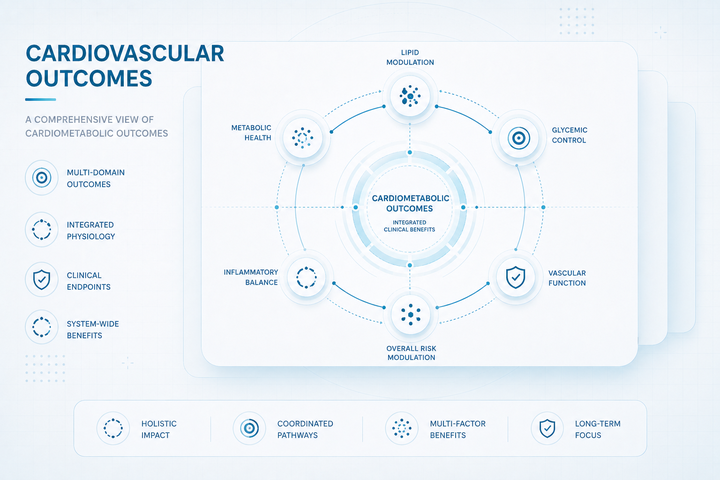
Semaglutide cardiovascular outcomes are best interpreted through interacting physiological systems rather than as an isolated pharmacologic endpoint. Its relationship with GLP-1 biology, mechanism, glycemic control, and insulin resistance provides a framework for understanding endocrine and metabolic signals that intersect with cardiovascular physiology without presuming a specific clinical outcome.
Cardiometabolic interpretation also incorporates appetite regulation, gastrointestinal signaling, vascular biology, and systemic metabolic communication. These pathways can be considered alongside pharmacokinetics, pharmacodynamics, and clinical pharmacology to distinguish drug exposure, receptor-mediated activity, downstream physiology, and measured cardiovascular endpoints.
A mechanistic framework therefore separates biological plausibility from observed endpoint interpretation. Context from type 2 diabetes, obesity, clinical trials, and metabolic outcomes can help characterize populations and pathways while preserving a neutral distinction between mechanistic associations and cardiovascular outcome findings.
Cardiovascular physiology emerges from coordinated regulation of cardiac output, vascular resistance, endothelial function, renal handling, autonomic signaling, substrate availability, and inflammatory-metabolic communication. Semaglutide-related interpretation begins with GLP-1 biology and mechanism, then considers interactions with glycemic control, insulin resistance, and metabolic outcomes. These pathways describe physiological context rather than establishing a cardiovascular endpoint effect.
The cardiovascular system receives signals from pancreatic endocrine tissues, liver, gastrointestinal organs, adipose tissue, and central appetite networks. Accordingly, appetite regulation, glycemic variability, and broader clinical pharmacology can be incorporated into a systems model. Such integration helps distinguish direct receptor-mediated signaling from indirect changes in substrate flux, hormonal tone, gastrointestinal physiology, and energy-regulatory signaling.
Cardiometabolic physiology also depends on the temporal relationship between pharmacologic exposure and downstream biological signals. Pharmacokinetics describes systemic exposure, while pharmacodynamics describes receptor-linked biological activity and downstream responses. Interpretation can therefore consider type 2 diabetes, obesity, and clinical trials as contextual variables without converting mechanistic relationships into cardiovascular-risk or outcome claims.
| Physiological domain | Mechanistic relevance | Interpretive focus |
|---|---|---|
| Cardiac physiology | Autonomic and metabolic signaling | System-level context |
| Vascular physiology | Endothelial tone and resistance | Signal integration |
| Metabolic physiology | Glucose and substrate handling | Indirect cardiovascular pathways |
Endothelial biology connects circulating metabolic signals with vascular tone, barrier function, nitric-oxide signaling, oxidative balance, leukocyte interactions, and local inflammatory pathways. A semaglutide-centered framework can relate GLP-1 biology to mechanism, pharmacodynamics, and clinical pharmacology while recognizing that receptor expression, signaling competence, tissue exposure, and downstream coupling determine how biological observations should be interpreted.
Vascular signaling is also influenced by systemic metabolic state. Changes in glucose handling, insulin signaling, substrate utilization, and gastrointestinal communication may alter the physiological environment surrounding endothelial cells. Consequently, glycemic control, insulin resistance, glycemic variability, and metabolic outcomes can provide mechanistic context without implying that any single pathway determines a cardiovascular endpoint.
The distinction between direct and indirect vascular mechanisms is important. Pharmacokinetics characterizes exposure, whereas pharmacodynamics characterizes biological response over time. Vascular interpretation may therefore integrate endocrine, metabolic, and gastrointestinal signals with appetite regulation and population context from obesity or type 2 diabetes. Mechanistic plausibility remains distinct from demonstrated cardiovascular outcome interpretation.
| Vascular component | Relevant signaling | Mechanistic interpretation |
|---|---|---|
| Endothelium | Nitric oxide and redox signaling | Vascular signaling context |
| Vascular smooth muscle | Contractile and metabolic signals | Tone regulation |
| Inflammatory interface | Cellular and cytokine communication | Systems interaction |
Glucose-dependent endocrine signaling is central to the metabolic interpretation of semaglutide. GLP-1 receptor activity in pancreatic islet physiology can influence glucose-sensitive insulin secretion and glucagon regulation, connecting GLP-1 biology, mechanism, and glycemic control. The glucose dependence of these pathways is important because endocrine signaling is dynamically coupled to prevailing metabolic conditions rather than operating independently of glucose availability.
Insulin and glucagon coordinate hepatic glucose flux, peripheral substrate utilization, and endocrine feedback. Their effects can intersect with insulin resistance, glycemic variability, and broader metabolic outcomes. From a cardiovascular perspective, these pathways represent physiological intermediates that can modify systemic metabolic signaling, while their existence alone does not establish a particular vascular, cardiac, or clinical outcome.
The temporal dimension is captured through pharmacokinetics and pharmacodynamics. Exposure determines receptor-accessible drug concentrations, whereas pharmacodynamic coupling describes downstream endocrine activity. Interpretation may therefore consider clinical pharmacology, type 2 diabetes, and prediabetes as physiological contexts. This framework separates glucose-dependent endocrine signaling from broader claims about cardiovascular endpoints.
| Endocrine pathway | Physiological role | Cardiometabolic relevance |
|---|---|---|
| Insulin secretion | Glucose-responsive anabolic signaling | Substrate and metabolic regulation |
| Glucagon signaling | Hepatic glucose mobilization | Energy-flux coordination |
| Islet integration | Coupled endocrine feedback | Systemic metabolic context |
Metabolic physiology links glucose disposal, insulin sensitivity, hepatic substrate handling, adipose signaling, and energy balance with cardiovascular function. Semaglutide interpretation can therefore incorporate insulin resistance, glycemic control, and glycemic variability alongside metabolic outcomes. These relationships describe interconnected physiological domains rather than a single causal pathway from metabolic signaling to a cardiovascular endpoint.
Insulin resistance can alter compensatory endocrine activity, substrate partitioning, hepatic metabolism, and adipose tissue communication. Those changes intersect with GLP-1 biology and mechanism through glucose-dependent endocrine pathways and whole-body energy regulation. Context from type 2 diabetes and obesity can help characterize the metabolic environment in which cardiovascular physiology is being studied without treating metabolic markers as cardiovascular outcomes.
Systems interpretation also requires separation of biological pathway, measured biomarker, and clinical endpoint. Clinical pharmacology, pharmacokinetics, and pharmacodynamics establish exposure-response context, while clinical trials provide endpoint-specific evidence. The mechanistic framework therefore treats metabolic changes as potential physiological intermediates whose relationships with cardiovascular measurements require endpoint-specific interpretation.
| Metabolic domain | Principal pathway | Cardiovascular interpretation |
|---|---|---|
| Glucose metabolism | Insulin and glucagon regulation | Systemic substrate context |
| Insulin sensitivity | Peripheral and hepatic signaling | Metabolic environment |
| Energy balance | Central and peripheral pathways | Cardiometabolic integration |
The gastrointestinal tract communicates with endocrine pancreas, liver, adipose tissue, and central nervous system through nutrient sensing, enteroendocrine signaling, gastric motility, and neural pathways. Semaglutide-related interpretation can therefore connect GLP-1 biology with mechanism, clinical pharmacology, and appetite regulation. Gastrointestinal signaling is a physiological component of cardiometabolic integration rather than an isolated cardiovascular mechanism.
Nutrient delivery and gastrointestinal signaling influence postprandial glucose dynamics, pancreatic endocrine communication, and central satiety pathways. These effects intersect with glycemic control, glycemic variability, and metabolic outcomes. Such pathways may change the metabolic inputs reaching cardiovascular systems, but mechanistic association should remain separate from interpretation of cardiovascular endpoint data.
Pharmacologic timing adds another layer because systemic exposure and receptor activity evolve according to pharmacokinetics and pharmacodynamics. Gastrointestinal physiology can also interact with metabolic context in obesity and type 2 diabetes. Mechanistic analysis therefore considers gastrointestinal, endocrine, metabolic, and central pathways together while avoiding assumptions that any one pathway explains cardiovascular findings.
| GI pathway | Primary signal | Cardiometabolic interface |
|---|---|---|
| Enteroendocrine signaling | GLP-1 and nutrient sensing | Pancreatic and metabolic communication |
| Gastric motility | Nutrient transit | Postprandial physiology |
| Gut-brain signaling | Neural and hormonal signals | Appetite and energy regulation |
Appetite regulation represents a central component of whole-body energy homeostasis and can influence gastrointestinal, endocrine, hepatic, and adipose signaling. Semaglutide mechanisms can therefore be interpreted through appetite regulation, GLP-1 biology, and mechanism. Central satiety signaling interacts with nutrient intake and energy availability, creating physiological links between behavioral, endocrine, and metabolic domains.
Changes in nutrient intake alter substrate availability, gastrointestinal signaling, insulin dynamics, and hepatic metabolism. These pathways connect appetite biology with glycemic control, insulin resistance, and metabolic outcomes. In cardiovascular interpretation, appetite pathways are therefore considered indirect physiological contributors rather than standalone explanations for measured cardiovascular endpoints.
The relationship between exposure and appetite-related pharmacodynamics can be examined using pharmacokinetics and pharmacodynamics, while population context may include obesity and weight management. This distinction is important because central appetite signaling, metabolic physiology, and cardiovascular endpoints occur on different biological and measurement scales. Mechanistic integration should preserve those distinctions rather than infer endpoint causality from pathway proximity.
| Appetite pathway | Physiological signal | System-level connection |
|---|---|---|
| Central satiety | Neural GLP-1 signaling | Energy intake regulation |
| Gut-brain axis | Enteroendocrine and neural input | Metabolic communication |
| Energy balance | Nutrient availability | Endocrine and hepatic signaling |
Pharmacokinetics and pharmacodynamics provide complementary frameworks for interpreting semaglutide-related cardiovascular biology. Pharmacokinetics describes absorption, distribution, systemic exposure, metabolism, and elimination, whereas pharmacodynamics describes receptor engagement and downstream biological response. These concepts integrate with clinical pharmacology, GLP-1 biology, and mechanism when relating drug exposure to physiological processes.
Cardiovascular endpoints may reflect multiple biological timescales, including acute hemodynamic variables, intermediate metabolic signals, and longer-term clinical events. Accordingly, exposure-response interpretation should consider glycemic control, glycemic variability, and metabolic outcomes as potentially related but distinct domains. A pharmacodynamic signal does not automatically establish that a downstream cardiovascular endpoint is mediated by that signal.
Variability in exposure, receptor responsiveness, metabolic state, concomitant physiology, and endpoint ascertainment can affect mechanistic interpretation. Population context from type 2 diabetes, obesity, and clinical trials therefore matters. PK/PD analysis is most informative when it distinguishes exposure, target engagement, intermediate biomarkers, and cardiovascular endpoints rather than collapsing them into a single response variable.
| PK/PD concept | Definition | Endpoint relevance |
|---|---|---|
| Exposure | Systemic drug concentration over time | Pharmacologic context |
| Target engagement | Receptor-mediated activity | Mechanistic linkage |
| Response | Downstream biological effect | Exposure-response interpretation |
Cardiovascular-related biological response is potentially heterogeneous because pharmacologic exposure, receptor signaling, metabolic phenotype, baseline physiology, organ function, and concomitant biological pathways differ among populations. Semaglutide interpretation can therefore integrate pharmacokinetics, pharmacodynamics, clinical pharmacology, and mechanism. Variability should be treated as a feature requiring characterization rather than as evidence for a particular cardiovascular outcome.
Metabolic heterogeneity can involve differences in insulin resistance, glycemic control, glycemic variability, and metabolic outcomes. Gastrointestinal and appetite-related physiology may add further variation through nutrient intake, energy balance, and central signaling. These variables can influence intermediate physiology without providing a direct explanation for cardiovascular endpoint differences.
Interpretive variability also arises from differences in study populations, endpoint definitions, observation periods, background therapies, and measurement methods. Type 2 diabetes, obesity, and clinical trials provide distinct contexts in which mechanisms may be evaluated. A rigorous framework therefore separates pharmacologic heterogeneity from endpoint heterogeneity and avoids translating subgroup variation into generalized cardiovascular claims.
| Source of variability | Biological example | Interpretive implication |
|---|---|---|
| Pharmacokinetic | Exposure differences | Variable pharmacologic context |
| Physiological | Metabolic phenotype | Different signaling environment |
| Methodological | Endpoint definition | Comparability considerations |
Cardiovascular outcomes are clinical endpoints that can integrate numerous biological pathways simultaneously. Mechanistic interpretation should therefore distinguish endpoint observation from proposed mediation through GLP-1 biology, mechanism, glycemic control, or metabolic outcomes. A mechanistic pathway may be biologically plausible without being sufficient to explain the entirety of an observed endpoint pattern.
Potential intermediate domains include endocrine signaling, vascular physiology, substrate metabolism, gastrointestinal communication, and appetite regulation. These can be evaluated alongside insulin resistance, glycemic variability, and appetite regulation. Such biomarkers or physiological measures should not automatically be equated with cardiovascular outcomes because they represent different levels of biological organization and different measurement constructs.
Evidence interpretation can combine clinical trials, clinical pharmacology, pharmacokinetics, and pharmacodynamics. The resulting framework asks whether exposure, target engagement, intermediate physiology, and endpoint measurement align mechanistically, while maintaining uncertainty where causal links are not established. This approach supports interpretation without converting mechanism into outcome claims.
| Evidence level | Example | Interpretive role |
|---|---|---|
| Pharmacologic | Exposure and receptor activity | Mechanism characterization |
| Physiological | Endocrine or vascular biomarkers | Intermediate pathway context |
| Clinical | Defined cardiovascular endpoint | Endpoint-specific evidence |
A systems-level model places semaglutide within interconnected endocrine, metabolic, gastrointestinal, appetite, vascular, and pharmacologic networks. GLP-1 biology, mechanism, and clinical pharmacology provide the mechanistic foundation, while glycemic control, insulin resistance, and metabolic outcomes characterize metabolic intermediates relevant to cardiovascular physiology.
The same framework incorporates gastrointestinal nutrient signaling and central appetite regulation, linking appetite regulation with energy balance, endocrine communication, and substrate flux. Cardiovascular physiology is consequently represented as a downstream system receiving signals from multiple organs rather than as an isolated target. This prevents mechanistic interpretation from assigning a single pathway responsibility for complex cardiovascular endpoints.
Finally, pharmacokinetics and pharmacodynamics define temporal exposure-response relationships, while type 2 diabetes, obesity, and clinical trials define important contextual dimensions. Systems integration is therefore a framework for organizing evidence across biological scales. It does not itself establish cardiovascular benefit, risk modification, superiority, or a specific clinical outcome.
| System layer | Key components | Integration function |
|---|---|---|
| Pharmacologic | PK, PD, receptor signaling | Exposure-response framework |
| Physiological | Endocrine, metabolic, GI, appetite | Inter-organ communication |
| Clinical | Population and endpoint data | Outcome-specific context |
Relevant cardiovascular physiology includes cardiac output, vascular resistance, endothelial signaling, autonomic regulation, substrate metabolism, renal fluid handling, and communication between cardiovascular and metabolic organs. Semaglutide mechanistic interpretation can also consider pancreatic endocrine signaling, hepatic glucose regulation, gastrointestinal nutrient sensing, and central appetite pathways because these systems influence the physiological environment surrounding cardiovascular function. These relationships describe interconnected biological processes rather than establishing that any individual pathway determines a cardiovascular endpoint. Cardiovascular physiology therefore provides context for interpreting pharmacology without substituting for endpoint-specific clinical evidence.
A cardiovascular outcome is a defined clinical endpoint representing an event, measurement, or composite related to cardiovascular health. Mechanistically, such an endpoint can integrate numerous processes, including vascular signaling, cardiac physiology, metabolic regulation, endocrine activity, inflammation, renal function, and autonomic control. Therefore, an observed cardiovascular endpoint should not automatically be attributed to a single molecular pathway. Mechanistic interpretation asks whether pharmacologic exposure, receptor activity, intermediate physiological signals, and the measured endpoint form a coherent biological sequence while preserving uncertainty where causal mediation has not been established.
Pharmacokinetics describes systemic exposure over time, including processes governing absorption, distribution, metabolism, and elimination. Pharmacodynamics describes receptor engagement and downstream biological responses. Together, these concepts help determine whether a physiological observation is temporally and biologically compatible with pharmacologic exposure. Cardiovascular endpoints may occur on different timescales from receptor signaling or metabolic changes, so PK/PD interpretation requires attention to temporal relationships. It does not by itself demonstrate a cardiovascular clinical effect, because endpoint interpretation also depends on population characteristics, study design, endpoint definitions, and independent clinical evidence.
Endocrine signaling coordinates metabolism, vascular physiology, substrate availability, and energy regulation across multiple organs. Semaglutide-associated GLP-1 receptor activity is relevant to glucose-dependent pancreatic signaling involving insulin and glucagon, while endocrine pathways communicate with hepatic, gastrointestinal, adipose, and neural systems. These signals can influence the metabolic environment in which cardiovascular physiology operates. However, endocrine activity should be distinguished from a cardiovascular endpoint itself. Mechanistic interpretation therefore examines endocrine pathways as physiological intermediates and avoids assuming that their modulation necessarily explains a specific cardiovascular measurement or clinical event.
Metabolic physiology includes glucose handling, insulin sensitivity, hepatic substrate flux, adipose signaling, energy balance, and related endocrine feedback. These processes interact with cardiovascular physiology through substrate availability, vascular signaling, autonomic pathways, and systemic metabolic communication. Semaglutide mechanistic interpretation can therefore consider metabolic pathways as interconnected physiological intermediates. A metabolic measurement and a cardiovascular endpoint remain conceptually distinct, however. The presence of a plausible metabolic pathway does not establish that the pathway mediates a particular cardiovascular finding, because endpoint relationships require dedicated evidence and appropriate causal interpretation.
The gastrointestinal tract communicates with endocrine pancreas, liver, adipose tissue, and the central nervous system through nutrient sensing, enteroendocrine hormones, neural signaling, and gastrointestinal motility. These pathways influence postprandial metabolism, glucose dynamics, insulin and glucagon signaling, and energy regulation. Such processes can therefore form part of a cardiometabolic systems model. Their relevance to cardiovascular interpretation is indirect and context-dependent. Gastrointestinal mechanisms should not be treated as equivalent to cardiovascular outcomes, because physiological pathways, intermediate biomarkers, and clinical endpoints represent different levels of biological organization.
Appetite pathways regulate energy intake and communicate with gastrointestinal, endocrine, hepatic, adipose, and central nervous system networks. GLP-1-related signaling can be considered within this broader gut-brain framework, where nutrient sensing and satiety signals influence energy balance and downstream metabolic physiology. These pathways may consequently alter the physiological inputs reaching cardiovascular systems. Mechanistically, however, appetite regulation is an intermediate physiological domain rather than a cardiovascular endpoint. Interpretation should distinguish central appetite signaling, changes in energy balance, metabolic responses, and directly measured cardiovascular outcomes rather than treating them as interchangeable.
Variability can arise from differences in pharmacokinetic exposure, receptor responsiveness, metabolic phenotype, organ function, baseline cardiovascular physiology, gastrointestinal signaling, appetite regulation, and study characteristics. Populations with different metabolic conditions may also have different endocrine and substrate environments in which pharmacologic signaling occurs. Endpoint definitions and measurement methods introduce additional variability. These factors mean that biological response and clinical endpoint patterns cannot necessarily be assumed to be uniform. Mechanistic analysis therefore treats heterogeneity as an important interpretive dimension rather than automatically assigning subgroup differences to a specific pharmacologic mechanism.
Glycemic endpoints characterize glucose-related physiology, such as circulating glucose patterns or measures reflecting longer-term glycemic exposure. Cardiometabolic endpoints encompass a broader collection of physiological or clinical variables involving cardiovascular, metabolic, endocrine, and vascular systems. Glycemic regulation can be one component of cardiometabolic physiology, but it does not represent the entire system. Consequently, a mechanistic relationship with glucose metabolism should not automatically be interpreted as a relationship with a cardiovascular endpoint. Clear analysis requires identifying the biological variable being measured and distinguishing it from broader cardiometabolic constructs.
Metabolic endpoints generally characterize processes such as glucose regulation, insulin sensitivity, lipid handling, substrate utilization, or energy balance. Cardiometabolic endpoints extend across metabolic and cardiovascular physiology and may include vascular, hemodynamic, cardiac, or composite clinical measures. The categories can overlap because metabolic signaling influences cardiovascular systems, but they remain analytically distinct. A metabolic change therefore provides mechanistic context rather than automatically serving as evidence for a cardiovascular effect. Interpretation should identify the specific endpoint, its biological level, and the evidence connecting it with pharmacologic exposure or downstream physiology.
Appetite endpoints describe aspects of hunger, satiety, food intake, or central energy-regulatory signaling, whereas cardiometabolic endpoints encompass broader cardiovascular and metabolic physiology. Appetite regulation can influence energy balance and nutrient availability, which may subsequently affect endocrine and metabolic pathways. Nevertheless, an appetite-related measure is not equivalent to a cardiovascular endpoint. Mechanistic interpretation should therefore preserve the sequence between central appetite signaling, gastrointestinal and endocrine responses, metabolic changes, and cardiovascular measurements. This distinction helps prevent indirect physiological relationships from being interpreted as direct evidence concerning cardiovascular outcomes.
Mechanistic evidence helps explain how pharmacologic exposure could interact with biological systems that participate in cardiovascular physiology. It can connect receptor signaling with endocrine, metabolic, gastrointestinal, appetite, endothelial, hepatic, and autonomic pathways. This framework is useful for organizing hypotheses and interpreting intermediate biomarkers, but mechanistic plausibility is not equivalent to clinical endpoint evidence. Cardiovascular outcomes require endpoint-specific assessment because complex events can reflect multiple pathways simultaneously. A rigorous interpretation therefore combines mechanistic biology with pharmacology, study design, population context, and direct evidence concerning the cardiovascular endpoint being evaluated.