Mechanistic comparison • PK/PD integration

Semaglutide vs Saxenda: Mechanistic Comparison

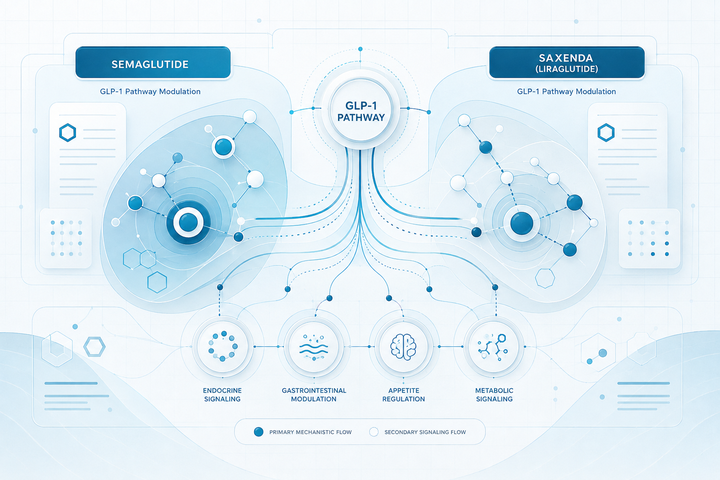
Semaglutide versus Saxenda, the liraglutide formulation, can be examined as a mechanistic comparison between two GLP-1 receptor agonists. Both engage GLP-1 receptor biology, linking receptor activation with intracellular signaling, endocrine physiology, gastrointestinal processes, appetite regulation and metabolic pathways. This framework connects GLP-1 biology, mechanism, pharmacodynamics, pharmacokinetics, clinical pharmacology and appetite regulation without assigning comparative clinical outcomes.

The comparison becomes more informative when receptor pharmacology is interpreted alongside exposure characteristics and downstream physiology. Endocrine signaling includes glucose-dependent insulin secretion, glucagon regulation and nutrient-responsive hormonal networks, while gastrointestinal pathways include gastric motor function and nutrient transit. Relevant context includes glycemic control, glycemic variability, insulin resistance, obesity and weight management as physiological domains rather than predetermined outcomes.

Mechanistic interpretation also requires separation of molecular similarity from pharmacokinetic behavior, pharmacodynamic persistence and interindividual variability. Semaglutide and liraglutide share a receptor target but differ in molecular structure, albumin association, exposure profiles and temporal signaling characteristics. Evidence from clinical trials can therefore be interpreted alongside metabolic outcomes, prediabetes and type 2 diabetes while maintaining a distinction between mechanistic evidence and clinical-effect interpretation.

1. Semaglutide vs Saxenda Mechanistic Comparison Framework
Weight comparison

Semaglutide and Saxenda, which contains liraglutide, belong to the GLP-1 receptor agonist class and therefore share a central receptor-mediated biological framework. Comparative interpretation begins with GLP-1 biology, mechanism, receptor activation, intracellular signaling and tissue-level pharmacodynamics. Their shared target does not make their molecular behavior identical, because ligand structure, receptor engagement, disposition and exposure can influence temporal signaling. These dimensions form the basis for a neutral clinical pharmacology comparison rather than an outcome ranking.

A useful comparison separates molecular pharmacology from downstream physiological domains. Receptor activation can influence pancreatic endocrine signaling, gastrointestinal motor pathways, central appetite circuits and glucose-regulatory networks. Those domains intersect with appetite regulation, glycemic control, insulin resistance, glycemic variability and broader metabolic outcomes. Mechanistic comparison therefore considers how a common receptor target is translated through multiple physiological systems rather than treating the medications as interchangeable molecular entities.

Clinical evidence can provide observations that inform mechanistic interpretation, but observed endpoints remain distinct from receptor pharmacology. Studies involving clinical trials, type 2 diabetes, prediabetes, obesity and weight management may contain measurements reflecting several biological pathways simultaneously. A mechanistic hub therefore emphasizes pathway attribution, exposure-response relationships and system integration without converting those observations into treatment recommendations or superiority conclusions.

Comparison layer Mechanistic focus Interpretive role
Molecular GLP-1 receptor activation and intracellular signaling Defines shared receptor biology
Pharmacokinetic Absorption, distribution, metabolism and elimination Frames exposure over time
Physiological Endocrine, gastrointestinal, appetite and metabolic pathways Connects signaling with systems physiology

2. GLP-1 Receptor Biology Comparison

The GLP-1 receptor is a class B G protein-coupled receptor expressed across several tissues involved in nutrient sensing and metabolic regulation. Semaglutide and liraglutide both act as receptor agonists, making GLP-1 biology the principal shared mechanistic layer. Receptor activation engages intracellular signaling pathways that can include cyclic AMP-dependent processes and downstream protein kinase activity. Interpretation is further informed by mechanism, pharmacodynamics and clinical pharmacology rather than by receptor nomenclature alone.

GLP-1 receptor signaling is context dependent because receptor density, cellular phenotype, nutrient state and downstream coupling influence biological translation. Pancreatic beta-cell signaling contributes to glucose-dependent insulin secretion, while alpha-cell signaling is associated with glucagon regulation under relevant physiological conditions. These pathways intersect with glycemic control, glycemic variability and insulin resistance. Central and gastrointestinal receptor pathways also contribute to the broader network represented by appetite regulation and nutrient-handling physiology.

Although receptor activation provides a common biological denominator, ligand structure and exposure can modify the temporal pattern of receptor stimulation. Consequently, comparison requires integration of receptor pharmacology with pharmacokinetics, pharmacodynamics and downstream endocrine physiology. Evidence discussed in clinical trials may capture composite effects from multiple receptor-expressing tissues, so mechanistic interpretation benefits from distinguishing direct receptor-mediated processes from secondary metabolic or gastrointestinal consequences.

Biological level Shared GLP-1 pathway Comparison variable
Receptor GLP-1 receptor agonism Ligand molecular characteristics
Intracellular cAMP-associated signaling Signal duration and cellular context
Systemic Endocrine and metabolic integration Exposure-dependent temporal pattern

3. Pharmacokinetic and Pharmacodynamic Comparison

Pharmacokinetic comparison examines how semaglutide and liraglutide reach, distribute through and leave the biological system, while pharmacodynamics examines how exposure is translated into receptor-mediated effects. Relevant concepts include pharmacokinetics, pharmacodynamics, clinical pharmacology and mechanism. Molecular features such as peptide structure, albumin binding and enzymatic stability can influence disposition. These properties establish exposure profiles that shape the temporal context for GLP-1 receptor signaling without implying a predetermined clinical outcome.

Semaglutide and liraglutide differ in structural modifications that affect proteolytic stability, plasma protein association and systemic disposition. Such differences can alter exposure persistence and the relationship between circulating concentrations and receptor-mediated physiology. Mechanistic interpretation therefore considers pharmacokinetics together with pharmacodynamics, GLP-1 biology, endocrine pathways only if such a page exists; because it is not in the approved link set, endocrine interpretation is instead connected through glycemic control and appetite regulation.

Exposure-response analysis also has to account for pharmacodynamic hysteresis, receptor signaling kinetics, tissue distribution and biological feedback. Measurements from clinical trials can represent integrated exposure and physiological response rather than a direct readout of receptor activation. Related domains include glycemic variability, metabolic outcomes, obesity and weight management. A mechanistic comparison therefore treats PK and PD as explanatory layers connecting molecular structure with system-level observations.

PK/PD layer Semaglutide or liraglutide variable Mechanistic significance
Disposition Protein association and metabolic stability Influences systemic exposure
Exposure-response Concentration and receptor signaling relationship Frames pharmacodynamic translation
Temporal biology Persistence of receptor stimulation Shapes duration of signaling context

4. Endocrine-Linked Comparison Pathways

Endocrine interpretation centers on GLP-1 receptor signaling in pancreatic islet cells and its relationship to nutrient-dependent hormone secretion. Both semaglutide and liraglutide can be analyzed through GLP-1 biology, mechanism and pharmacodynamics. Beta-cell signaling involves glucose-dependent insulin secretion, while alpha-cell regulation can modify glucagon dynamics. These mechanisms interact with glycemic control, glycemic variability and the broader endocrine-metabolic network.

The endocrine response is not determined solely by receptor occupancy. Ambient glucose concentration, nutrient availability, beta-cell functional state, insulin sensitivity and counter-regulatory signaling can modify the physiological expression of GLP-1 receptor activation. Consequently, insulin resistance provides an important metabolic context, while type 2 diabetes and prediabetes represent disease contexts in which multiple endocrine pathways may be simultaneously altered. These contexts are mechanistic descriptors rather than evidence of a particular comparative effect.

Temporal exposure also matters because endocrine signaling can reflect changing receptor stimulation over time. PK characteristics from pharmacokinetics interact with receptor-level pharmacodynamics, while downstream physiology intersects with metabolic outcomes and clinical trials. Interpretation is therefore strongest when hormone secretion, glucose sensing, insulin sensitivity and ligand exposure are considered as linked components rather than isolated endpoints.

Endocrine pathway Mechanistic process Relevant context
Beta-cell signaling Glucose-dependent insulin secretion Nutrient and glucose state
Alpha-cell signaling Glucagon regulation Metabolic and glycemic context
Insulin sensitivity Interaction with insulin-responsive tissues Insulin resistance physiology

5. Gastrointestinal-Linked Comparison Pathways

Gastrointestinal interpretation involves GLP-1 receptor signaling across neural, enteric and gastrointestinal pathways that influence gastric motor activity, nutrient transit and postprandial signaling. Semaglutide and liraglutide can therefore be compared through GLP-1 biology, mechanism, pharmacodynamics and clinical pharmacology. Gastric emptying is a particularly relevant physiological bridge between receptor activation, nutrient delivery and downstream endocrine signaling, connecting gastrointestinal physiology with glycemic control.

Gastrointestinal signaling is dynamic and can vary with meal composition, gastric motor state, autonomic activity and prior exposure to GLP-1 receptor agonism. These variables can influence the temporal delivery of nutrients to the small intestine and consequently modify postprandial endocrine signals. The pathway intersects with appetite regulation, glycemic variability, insulin resistance and metabolic outcomes without establishing a specific clinical consequence.

PK/PD interpretation helps explain why gastrointestinal receptor activation should be viewed as an exposure-dependent process rather than a static drug property. Pharmacokinetics describes systemic exposure, whereas pharmacodynamics describes physiological translation. Evidence from clinical trials may include gastrointestinal observations alongside metabolic and appetite-related measures, making systems-level attribution important when comparing semaglutide with Saxenda.

GI pathway Mechanistic process Systems connection
Gastric motor function Altered gastric emptying dynamics Nutrient delivery and postprandial signaling
Enteric signaling GLP-1-linked neural and local pathways GI-brain communication
Nutrient transit Temporal modulation of intestinal exposure Endocrine and glycemic integration

6. Appetite-Linked Comparison Pathways

Appetite-related interpretation involves GLP-1 receptor signaling within central and peripheral networks that integrate nutrient status, gastrointestinal feedback and hypothalamic or brainstem processing. Semaglutide and liraglutide share this receptor-level framework, which can be examined through GLP-1 biology, mechanism, appetite regulation and clinical pharmacology. Peripheral gastrointestinal signals can converge with central neural pathways, creating an integrated appetite-control network rather than a single anatomical mechanism.

Appetite signaling reflects interactions among meal-related sensory information, gastric distension, intestinal nutrient sensing, circulating metabolic signals and central neural processing. These mechanisms connect appetite regulation with obesity, weight management, metabolic outcomes and broader metabolic physiology. The presence of a shared receptor target does not mean that all downstream signals have identical temporal behavior, because ligand exposure and tissue-level pharmacodynamics contribute to the overall signaling environment.

PK/PD relationships are particularly relevant when appetite pathways are considered longitudinally. Pharmacokinetics establishes exposure patterns, while pharmacodynamics describes biological translation at receptor-expressing tissues. Observational and experimental evidence from clinical trials can contain appetite-related measurements, but these measurements may reflect multiple interacting pathways. Mechanistic interpretation therefore distinguishes receptor-mediated signaling, gastrointestinal feedback and higher-order behavioral physiology rather than assigning a singular causal explanation.

Appetite component Mechanistic pathway Integration
Central signaling GLP-1 receptor-linked neural circuits Brain-mediated nutrient appraisal
Peripheral feedback Gastrointestinal and metabolic signals Meal-related feedback
Exposure relationship PK/PD-linked receptor stimulation Temporal signaling context

7. Metabolic-Linked Comparison Pathways

Metabolic comparison links GLP-1 receptor signaling with glucose homeostasis, insulin secretion, glucagon regulation, nutrient handling and energy-balance physiology. Semaglutide and liraglutide can be placed within this framework using GLP-1 biology, mechanism, insulin resistance, glycemic control and metabolic outcomes. These pathways are interconnected, so an observed metabolic variable may reflect several simultaneous physiological processes rather than one isolated receptor effect.

Insulin sensitivity modifies the relationship between GLP-1-mediated endocrine signaling and tissue glucose disposal. In metabolic contexts such as type 2 diabetes, prediabetes and obesity, altered insulin responsiveness can coexist with changes in hepatic glucose production, beta-cell function and nutrient flux. These factors interact with glycemic variability and glycemic control. Mechanistic comparison therefore requires disease-state context without translating physiology into treatment recommendations.

Metabolic interpretation also depends on exposure and temporal signaling. Pharmacokinetics describes the concentration-time environment, while pharmacodynamics connects receptor stimulation to biological responses. The resulting systems network can be examined alongside appetite regulation, weight management and clinical trials. This approach keeps metabolic endpoints conceptually distinct from molecular mechanism while recognizing their physiological interdependence.

Metabolic domain Mechanistic pathway Interpretive connection
Glucose homeostasis Insulin and glucagon signaling Glycemic regulation
Insulin sensitivity Tissue responsiveness to insulin Metabolic state
Energy balance Appetite and nutrient signaling Whole-system integration

8. Variability in Semaglutide vs Saxenda Mechanistic Response

Interindividual variability can occur at several layers of a semaglutide versus Saxenda mechanistic comparison. Differences in absorption, distribution, protein binding, metabolic clearance, receptor biology and tissue responsiveness can alter exposure-response relationships. Relevant concepts include pharmacokinetics, pharmacodynamics, GLP-1 biology, mechanism and clinical pharmacology. Variability therefore should not be treated as unexplained noise when constructing a mechanistic model of receptor-mediated physiology.

Biological heterogeneity may include differences in beta-cell function, insulin sensitivity, gastrointestinal motility, autonomic signaling, appetite circuitry and baseline metabolic state. These variables can influence pathways associated with insulin resistance, glycemic variability, appetite regulation, obesity and type 2 diabetes. The same nominal receptor target can therefore operate within different physiological environments, creating heterogeneity in downstream signal expression without establishing a comparative clinical hierarchy.

Population studies and clinical trials can reveal distributions of pharmacodynamic or physiological measurements, but aggregate observations may conceal mechanistic subgroups. Interpretation can incorporate prediabetes, weight management, metabolic outcomes and glycemic control as contextual domains. A systems approach recognizes variability as the combined result of molecular exposure, receptor signaling, organ physiology and disease-state heterogeneity rather than assigning it to a single factor.

Variability layer Potential determinant Mechanistic consequence
Pharmacokinetic Absorption, distribution and clearance Different exposure profiles
Pharmacodynamic Receptor and tissue responsiveness Different signal translation
Physiological Metabolic and gastrointestinal state Different downstream expression

9. Glycemic Endpoint Interpretation

Glycemic endpoints represent downstream physiological measurements rather than direct measurements of GLP-1 receptor activation. Semaglutide and liraglutide can influence the mechanistic pathways underlying glucose regulation through pancreatic endocrine signaling, gastrointestinal nutrient delivery and appetite-related metabolic inputs. Relevant frameworks include glycemic control, glycemic variability, GLP-1 biology, mechanism and pharmacodynamics. These relationships describe biological linkage rather than comparative outcome claims.

Glycemic measurements can reflect multiple processes simultaneously, including insulin secretion, glucagon regulation, hepatic glucose production, peripheral glucose disposal and the timing of nutrient absorption. Their interpretation can therefore involve insulin resistance, type 2 diabetes, prediabetes and broader metabolic outcomes. A mechanistic comparison distinguishes the receptor-mediated initiating pathway from secondary physiological changes, avoiding the assumption that a measured glycemic endpoint directly quantifies molecular potency.

Exposure-response analysis provides another interpretive layer. Pharmacokinetics describes the concentration-time profile, while pharmacodynamics addresses biological translation. Evidence summarized through clinical trials may integrate glycemic endpoints with appetite, gastrointestinal and metabolic variables. Mechanistic interpretation is therefore strengthened when glycemic data are evaluated within the broader endocrine and nutrient-handling network rather than considered in isolation.

Glycemic measure Underlying pathway Mechanistic limitation
Glucose concentration Integrated glucose homeostasis Not a direct receptor readout
Glycemic variability Temporal glucose regulation Influenced by multiple physiological inputs
Postprandial response Nutrient delivery and endocrine signaling Depends on gastrointestinal and metabolic context

10. Multi-System Comparison Integration

A complete semaglutide versus Saxenda comparison integrates molecular, pharmacokinetic, pharmacodynamic, endocrine, gastrointestinal, appetite and metabolic layers. The central framework combines GLP-1 biology, mechanism, pharmacokinetics, pharmacodynamics and clinical pharmacology. Downstream systems include appetite regulation and glycemic control. This layered architecture avoids reducing the comparison to a single receptor or single physiological endpoint.

The systems perspective recognizes feedback between gastrointestinal nutrient handling, pancreatic hormone secretion, central appetite processing and peripheral metabolic state. These interactions can intersect with insulin resistance, glycemic variability, metabolic outcomes, obesity and weight management. Disease context can further modify pathway expression, including in type 2 diabetes and prediabetes. These domains are connected mechanistically but should not be interpreted as interchangeable endpoints.

Finally, mechanistic evidence should be separated from claims about clinical effectiveness. Clinical trials can provide integrated observations across endocrine, gastrointestinal, appetite and metabolic domains, while effectiveness overview provides a distinct evidence layer. The mechanistic comparison instead asks how molecular structure, exposure, receptor signaling and physiological feedback interact. This approach preserves biological nuance and accommodates variability without assigning superiority, treatment preference or predetermined outcomes to either semaglutide or Saxenda.

Systems layer Primary mechanism Integration with comparison
Molecular GLP-1 receptor signaling Common pharmacological target
Organ-level Endocrine and gastrointestinal physiology Connects receptor activation with nutrient handling
Whole-system Appetite and metabolic feedback Integrates exposure with physiological context

Frequently Asked Questions

Semaglutide versus Saxenda is fundamentally a comparison between two GLP-1 receptor agonists, semaglutide and liraglutide, examined through receptor pharmacology and downstream physiology. Both interact with the GLP-1 receptor, linking receptor activation to intracellular signaling, pancreatic endocrine regulation, gastrointestinal processes, appetite-related neural pathways and metabolic control. The mechanistic distinction is not simply the shared receptor target; molecular structure, exposure, receptor signaling kinetics and physiological context can influence how that common pathway is expressed over time.

GLP-1 receptor biology provides the principal shared mechanistic framework for semaglutide and liraglutide. Both molecules are engineered peptide agonists that activate the class B GLP-1 receptor, initiating intracellular signaling pathways that include cyclic AMP-related processes. Receptor activation can influence pancreatic beta-cell and alpha-cell physiology, gastrointestinal signaling and neural pathways involved in nutrient sensing. Their common receptor target establishes substantial mechanistic overlap, while molecular structure, receptor engagement characteristics, pharmacokinetics and tissue context provide additional dimensions for comparison.

PK/PD comparison connects molecular structure with the timing and persistence of biological signaling. Pharmacokinetics describes absorption, distribution, metabolism and elimination, while pharmacodynamics describes the relationship between exposure and receptor-mediated physiological effects. Semaglutide and liraglutide have different molecular modifications that influence stability, protein association and systemic disposition. Consequently, their receptor signaling environments can differ temporally even though both act at the GLP-1 receptor. Mechanistic interpretation therefore considers exposure profiles alongside receptor pharmacology and downstream endocrine, gastrointestinal, appetite and metabolic pathways.

Endocrine comparison centers on GLP-1 receptor signaling within pancreatic islet physiology and its relationship to glucose-dependent hormone secretion. Activation of beta-cell GLP-1 receptors can participate in glucose-dependent insulin secretory signaling, while alpha-cell pathways are relevant to glucagon regulation under physiological conditions. These processes interact with ambient glucose, insulin sensitivity, nutrient availability and counter-regulatory systems. Differences in exposure and signaling over time can therefore influence the mechanistic environment in which these endocrine pathways operate, without making endocrine physiology equivalent to a clinical outcome.

Gastrointestinal comparison involves GLP-1 receptor-linked pathways affecting gastric motor function, nutrient transit and gut-brain communication. Gastric emptying is particularly relevant because the timing of nutrient delivery can influence postprandial glucose appearance and endocrine signaling. Gastrointestinal neural and peripheral signals also interact with central appetite pathways. Semaglutide and liraglutide can therefore be examined through a network involving receptor activation, exposure, gastric physiology and nutrient sensing. The resulting physiology is dynamic and depends on meal context, gastrointestinal state and broader metabolic conditions.

Appetite-related comparison considers GLP-1 receptor signaling across central and peripheral networks that integrate nutrient status, gastrointestinal feedback and neural processing. Relevant mechanisms include brainstem and hypothalamic signaling, gastric distension, intestinal nutrient sensing and circulating metabolic information. Semaglutide and liraglutide share the GLP-1 receptor as a pharmacological target, but the temporal characteristics of receptor stimulation depend on molecular properties and systemic exposure. Appetite physiology therefore represents an integrated network rather than a single receptor location or isolated biological pathway.

Metabolic comparison includes glucose homeostasis, insulin secretion, glucagon regulation, insulin sensitivity, nutrient handling and energy-balance signaling. GLP-1 receptor activation can participate in these pathways through pancreatic and extra-pancreatic mechanisms. The physiological expression of those pathways depends on metabolic state, including insulin sensitivity, beta-cell function, nutrient availability and hepatic glucose regulation. Semaglutide and liraglutide can consequently be compared by examining how their molecular and pharmacokinetic properties interact with these metabolic systems, rather than treating a single metabolic measurement as a direct receptor-level observation.

Variability can arise from pharmacokinetic, pharmacodynamic and physiological sources. Pharmacokinetic factors influence systemic exposure, whereas pharmacodynamic factors include receptor responsiveness, tissue signaling and downstream cellular coupling. Physiological variables such as insulin sensitivity, beta-cell function, gastrointestinal motility, appetite circuitry and baseline metabolic state can further modify pathway expression. Consequently, two individuals or populations may exhibit different biological relationships between exposure and downstream measurements. Mechanistic variability is therefore best understood as a multilevel property of ligand disposition, receptor signaling and physiological context rather than as unexplained inconsistency.

Glycemic endpoints are downstream measurements reflecting integrated glucose homeostasis rather than direct measurements of GLP-1 receptor activation. They can incorporate insulin secretion, glucagon regulation, hepatic glucose production, peripheral glucose disposal and gastrointestinal nutrient delivery. Because several mechanisms contribute simultaneously, a glucose measurement cannot by itself identify the relative contribution of receptor signaling, exposure or insulin sensitivity. Mechanistic interpretation therefore places glycemic endpoints within the broader PK/PD and endocrine framework, recognizing that measured glucose physiology is an integrated system response rather than a singular molecular readout.

Metabolic endpoints can reflect coordinated changes across glucose regulation, insulin sensitivity, nutrient handling, energy balance and endocrine signaling. In a mechanistic comparison, these measurements are considered downstream expressions of several interacting pathways rather than direct indicators of receptor pharmacology. Semaglutide and liraglutide both activate the GLP-1 receptor, while molecular structure and exposure characteristics establish different pharmacological contexts. Interpretation therefore requires separation of receptor-mediated mechanisms from secondary physiological effects and consideration of disease state, baseline metabolism and feedback between endocrine, gastrointestinal and appetite systems.

Appetite endpoints represent integrated physiological and behavioral phenomena arising from central neural processing, gastrointestinal feedback, nutrient sensing and circulating metabolic signals. GLP-1 receptor activation participates in this network, but appetite-related observations cannot generally be reduced to receptor occupancy alone. For semaglutide and liraglutide, molecular structure, systemic exposure and temporal receptor stimulation provide part of the mechanistic context. Gastric motor signals and central appetite circuitry add further layers. Consequently, appetite measurements are best viewed as system-level outputs of interconnected pathways rather than isolated pharmacological markers.

Mechanistic evidence helps connect molecular pharmacology with physiological observations by identifying receptor targets, intracellular signaling, exposure relationships and downstream organ systems. For semaglutide and liraglutide, this includes GLP-1 receptor activation, pharmacokinetics, pharmacodynamics, endocrine signaling, gastrointestinal physiology and appetite-related neural pathways. Mechanistic studies can clarify biological plausibility and pathway relationships, while clinical studies provide integrated observations that may involve several mechanisms simultaneously. Keeping these evidence layers distinct allows comparative interpretation without converting mechanistic similarity or difference into unsupported claims about clinical superiority or treatment choice.